
California Sycamore: How to Identify It and Whether to Plant One
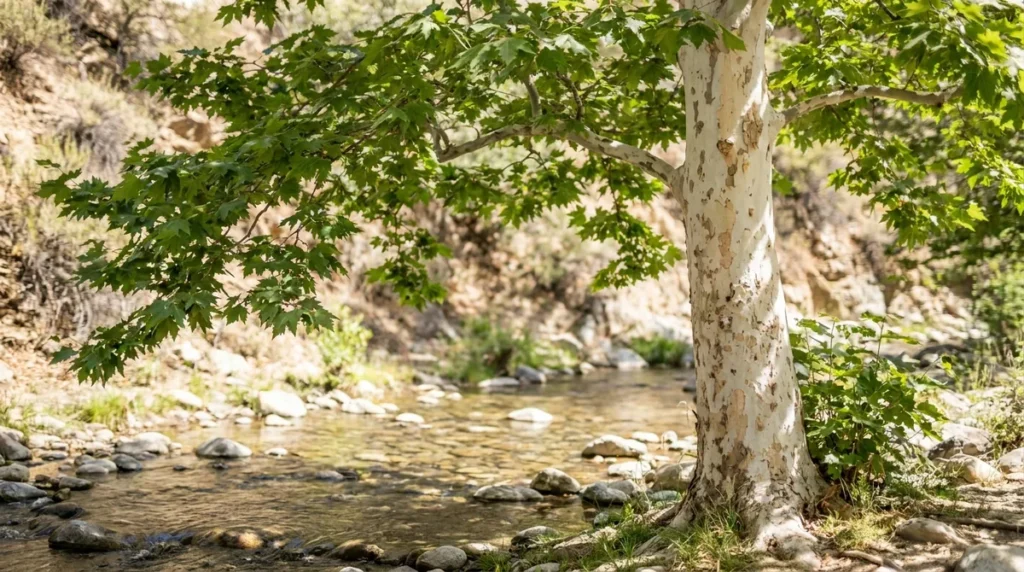
The California sycamore (Platanus racemosa) is the plane tree native to California's creeks, canyons and floodplains. It is not the American sycamore (Platanus occidentalis) of the eastern United States, and it has nothing to do with the British "sycamore," which is a maple, Acer pseudoplatanus — a different genus with helicopter seeds. Plant a California sycamore if you have room and a source of summer moisture. If you have neither, it will disappoint you.
- The trunk tells you first: it almost never grows straight
- Count the seed balls on the stalk
- Leaves and bark, when there is no fruit on the tree
- How it compares with the American and Mexican sycamores
- A riparian tree in a dry state — the part nobody tells you
- Anthracnose will disfigure it in a wet spring
- How big it gets, and how far from the house
- What it feeds and shelters
- So should you plant one?
The trunk tells you first: it almost never grows straight
If you learned sycamores in Ohio or Indiana, the California tree looks wrong. P. occidentalis usually rises as one massive, more or less vertical column. P. racemosa leans. The trunk twists, tilts out over the streambed and very often forks low into several spreading or leaning secondary trunks, so a mature tree can read as a clump rather than a single stem. Multi-trunked specimens are normal, not damaged.
That habit is not a defect of cultivation — it is what the species does in the canyons where it grows, and it is the fastest way to recognize one from a car window in Southern California. It also has a practical consequence: a leaning, low-forking tree with a wide crown needs more clear space than its height suggests, and it is harder to prune into a street-tree shape. Nurseries that stake and train young stock hard are fighting the tree's nature.
Count the seed balls on the stalk
This is the field mark that settles every argument, and it is in the name. Racemosa refers to the way the fruit is arranged: California sycamore carries its seed heads in a string, typically two to seven along a single hanging stalk. American sycamore carries one ball per stalk, almost without exception. London plane (Platanus × acerifolia), the tree planted in city streets worldwide, usually carries two, sometimes three.
So: several balls on one stalk in California, and you are almost certainly looking at P. racemosa or a hybrid with London plane. One ball, and you are looking at an American sycamore — planted, because it is not native west of the Rockies.
One thing those balls are not: they are not samaras. Every Platanus produces dry achenes packed into a spherical head that shatters into fuzz over winter. The winged, spinning "helicopter" seeds belong to maples. If a page tells you a sycamore drops helicopters, it has confused the American tree with the British one, and you can stop reading it. More field marks are collected in our sycamore tree identification guide.
Leaves and bark, when there is no fruit on the tree
The leaf is palmate with three to five lobes, and the lobes are cut deeper and are narrower than on the American sycamore — longer than they are wide, with broad open sinuses between them. Where P. occidentalis reads as a broad, shallowly notched, coarsely toothed leaf, P. racemosa reads as a star. Margins are entire or only lightly toothed. Both species carry large alternate leaves on a petiole whose swollen base hides next year's bud.
Bark is the classic plane-tree patchwork: dark brown and furrowed at the base of an old trunk, then flaking off higher up in irregular plates to leave a mottled surface of white, tawny beige, pinkish gray and pale green. On the upper limbs it goes nearly white, which is why a sycamore-lined creek is visible from a ridge a mile away in winter.
How it compares with the American and Mexican sycamores
| California sycamore P. racemosa | American sycamore P. occidentalis | Mexican sycamore P. mexicana | |
|---|---|---|---|
| Native range | California and northern Baja California, along streams and canyons | Eastern and central United States | Northeastern Mexico, planted widely in south and central Texas |
| Mature height | 50–80 ft (15–25 m) | 75–115 ft (23–35 m) in cultivation | 50–80 ft (15–24 m) |
| Crown spread | 30–70 ft (9–21 m) | 65–100 ft (20–30 m) | 40–60 ft (12–18 m) |
| Seed balls per stalk | 2–7 | 1 | Usually more than one |
| Trunk form | Leaning, twisting, often multi-trunked | Single, straight, massive | Usually single, upright |
| USDA zones | 7–10 | 4–9 | 8–10 (reliable from 8b) |
| Selling point | Native habitat value, canyon character | Size and speed on deep moist soil | Drought and alkaline soil tolerance, better anthracnose resistance |
If your problem is heat, alkaline soil and no water, the honest answer is often the Mexican sycamore, not this one. If you are east of the Rockies, the tree you actually want is the American sycamore. The full family is laid out in our guide to sycamore tree types.
A riparian tree in a dry state — the part nobody tells you
Here is the nuance that gets skipped in most listings. P. racemosa is genuinely drought-adapted in the sense that it survives a California summer with no rain at all. It is not drought-adapted in the sense that it will thrive on a xeriscape drip line. In the wild it grows where the water table is within reach: streambanks, springs, seeps, canyon bottoms, alluvial flats. It endures the dry season because its roots are in groundwater, not because it needs little.
Transplant that tree into a lawnless front yard on shallow soil and you get a thin, stressed, early-yellowing specimen. Give it deep, infrequent irrigation for the first several years, plant it where runoff collects rather than on a mound, and it becomes fast and vigorous. Mapping and regeneration work by the San Francisco Estuary Institute in Santa Clara County found that healthier, living sycamores sat closer to the creek channel than dead or declining ones, and that flooding, while not sufficient on its own, was necessary for successful natural regeneration. The tree is telling you what it wants. General watering, mulching and pruning practice is covered in sycamore tree care.
Anthracnose will disfigure it in a wet spring
California sycamore is very susceptible to sycamore anthracnose, and in coastal and inland-valley California it gets it most years. The fungus is worst when the average daily temperature during leaf-out and the following two weeks stays below about 55°F — exactly the cool, damp spring that much of the state gets. Shoots blight, leaves brown along the veins and drop, and a tree can defoliate almost completely in April.
Two things to hold onto. First, an established tree refoliates: the second flush of growth generally fills the canopy back in by early summer. Second, repeated infection is disfiguring rather than fatal — it kills twigs, costs the tree apical control and produces the crooked, zigzag branching that gives old California sycamores their character. It rarely kills a mature tree outright. Raking and removing fallen leaves and twigs, and pruning out blighted wood in fall or winter, reduces the spore load for the following spring. See sycamore tree diseases for the rest of the picture.
How big it gets, and how far from the house
Expect 50–80 ft (15–25 m) tall with a 30–70 ft (9–21 m) crown, at roughly 2–3 ft (60–90 cm) of growth a year on a good site, and a working lifespan of 150–250 years. Plant it at least 40–50 ft (12–15 m) from the house.
The reason for that distance is not the myth. Sycamore roots do not push sound foundations apart. The real risks are that a water-seeking riparian root system will dry out a clay soil enough to cause differential settlement, and that it will find and exploit a sewer or drain line that already had a crack in it. Keep it well away from septic fields, and leave it out from under overhead power lines entirely — there is no pruning regime that reconciles a 70 ft tree with a distribution line. We go through the mechanisms in managing sycamore tree roots near structures.
What it feeds and shelters
This is the strongest argument for planting one inside its native range. P. racemosa is a larval host plant for the western tiger swallowtail, and hummingbirds strip the fuzz from the underside of its leaves to line their nests. Large old trees develop cavities, broken limbs and rough bark that support woodpeckers, kingbirds, raptors, small mammals and wood-boring insects — the structural complexity a young landscape tree simply cannot offer.
At landscape scale, the species defines sycamore alluvial woodland, an open woodland community that the San Francisco Estuary Institute describes as unique and relatively rare in California, tied to dynamic stream processes and to periodic flooding. Its decline is driven by altered creek hydrology, anthracnose, and hybridization with planted London plane trees. A native sycamore planted near a creek corridor is doing something a nursery cultivar cannot.
So should you plant one?
Plant it if you are in USDA zone 7–10 in California or the Southwest, you have 40 ft or more of clearance from structures and pipes, you can water deeply for the first three or four years, and you want a fast, native, wildlife-rich shade tree with real character. Plant it especially if your site is a swale, a low corner, or anywhere runoff naturally gathers.
Skip it if your lot is small, if you are within 40 ft of the foundation or the sewer line, if you cannot tolerate a tree that looks ragged for six weeks every spring, or if you want a symmetrical specimen. Skip it too if your real constraint is alkaline soil and no irrigation — that is the Mexican sycamore's job. And if you simply like the look of plane bark on a city street, the tree you have been admiring is probably a London plane, not this one.
Recommended: