
American vs Mexican Sycamore: Which One Should You Plant?
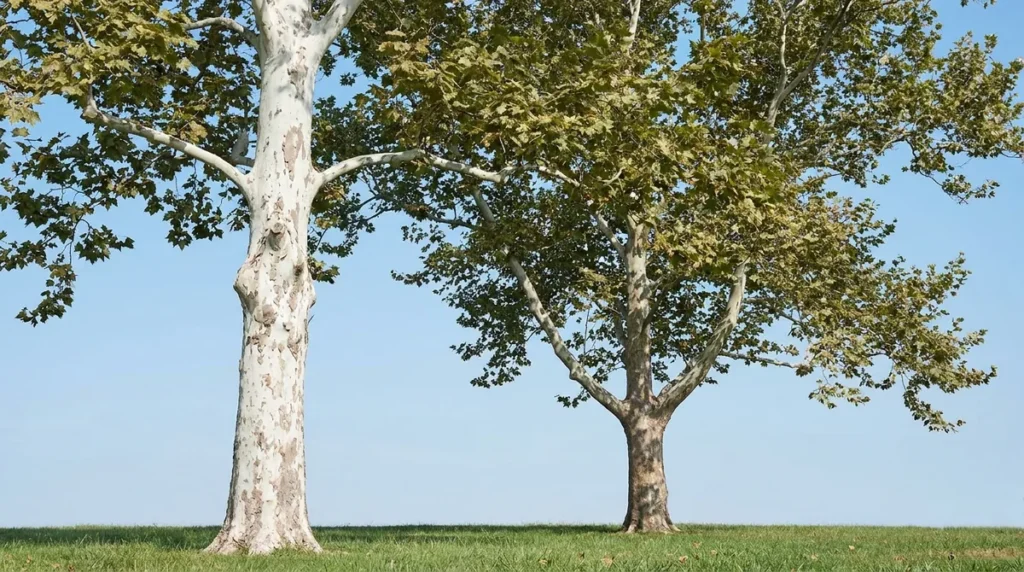
Choose by climate, not by looks. In alkaline, drought-prone country — Central and South Texas, the Southwest — the Mexican sycamore (Platanus mexicana) wins clearly. In the humid East, and anywhere with a real winter, the American sycamore (Platanus occidentalis) wins, because the Mexican one simply is not cold-hardy.
Both of these are true sycamores in the botanical sense: two species of the genus Platanus, with the same flaking camouflage bark and the same dangling seed balls. That already sets them apart from the other two trees that answer to "sycamore" — the British sycamore (Acer pseudoplatanus), which is a maple, and the sycamore fig (Ficus sycomorus) of Egypt and the Book of Luke. Neither of the trees on this page produces helicopter seeds; those belong to the maple. If you want the wider map of the name, the guide to sycamore tree types lays out all of them.
The number that settles most of this argument
Hardiness. The American sycamore is rated for USDA zones 4 to 9. The Mexican sycamore is rated for zones 8 to 10, and only reliably from 8b. That is a four-zone gap, and zones are 10 °F apart, so it is not a rounding difference — it is roughly 40 °F of winter separating the two trees.
Zone 8b bottoms out at about 15–20 °F. Zone 4 bottoms out near −30 °F. An American sycamore is a Minnesota tree. A Mexican sycamore is a San Antonio tree that gets nervous in Dallas.
Be careful here, because this is the single most corrupted fact in the whole comparison. Several pages rank for "Mexican sycamore" while assigning it zones 4–9 — the American sycamore's rating, pasted onto a tree native to northeastern Mexico. It is wrong by four zones, and following it will cost you a tree in the first hard freeze. The institutional position is narrower: UF/IFAS states plainly that this species' cold hardiness is not well defined, and that it grows well as far north as zone 8b in Texas and Florida. Oregon State's landscape plant database lists it simply as "hardy to USDA Zone 8." Nobody with a herbarium behind them puts it in zone 4.
Which one can survive your soil?
The American sycamore is a bottomland tree. It tolerates a soil pH of roughly 4.9 to 7.5 and wants deep, moist ground; it will take periodic flooding and urban compaction without complaint. Its real limit is not cold, it is prolonged drought — and, in the limestone belt, alkalinity. Central Texas soils are both alkaline and clay-heavy, and chlorosis in trees planted there is the routine result.
The Mexican sycamore handles what the American one cannot: caliche and alkaline soil up to about pH 8.5, plus real drought once it is established. Oregon State describes it as adapted to most soils including alkaline ones and drought tolerant, but needing irrigation until established — in practice, water it through its first three years.
Does the Mexican sycamore really shrug off anthracnose?
Partly. Less than the internet claims, and for a reason most pages get backwards.
Sycamore anthracnose (Apiognomonia veneta) is the most serious disease of the genus, and Colorado State University Extension is explicit that American sycamore is far more susceptible than London plane or Oriental plane. It blights emerging leaves, kills twig ends back several inches and eventually forms cankers on branches.
But the Mexican sycamore is not immune. UF/IFAS lists anthracnose as one of two fungal diseases that do affect it, causing moderate to severe leaf drop during cool, wet springs. What is genuinely documented in its favor is different: it is resistant to bacterial leaf scorch, a disease that can eventually kill an American sycamore, and Florida observations found sycamore lace bug infestations less severe on it than on the native species.
And here is the part almost nobody says out loud. Anthracnose severity is decided by weather, not by species alone. CSU's threshold: if the average temperature in the two weeks after the first leaves emerge stays below 55 °F, the shoot-blight phase is serious; above 60 °F, there is little or none. Austin's March normal averages around 63 °F. So a Mexican sycamore in Central Texas looks clean partly because of where it is planted, not only because of what it is — an American sycamore in the same spot would also see far less anthracnose than one in Ohio. Our full breakdown of sycamore tree diseases covers the symptoms and the spray timing.
How to tell them apart with the tree in front of you
Turn a leaf over. That is the whole test. The Mexican sycamore's underside is covered in dense off-white woolly hairs and reads as silver, even from a distance; run your hand across it and it feels like felt. The American sycamore's underside is pale green and only lightly hairy along the veins.
One caveat that resolves most disappointed buyers: UF/IFAS notes the silvery underside develops on mature trees, at least four to six years old. A nursery sapling that has not yet developed it is not necessarily an impostor.
Two backup checks. Leaf margin: Virginia Tech describes American sycamore leaves as coarsely toothed, while Oregon State gives the Mexican sycamore an entire margin, mostly with five pointed lobes and rarely toothed. Leaf outline: American sycamore leaves are broader at the base and usually carry an extra lobe the Mexican one lacks.
What does not work is the fruit. Both species carry one or two seed balls per stalk, so the peduncle count that separates American sycamore from London plane is useless here. Neither tree makes samaras. More field checks in the sycamore tree identification hub.
Side by side
| American sycamore (P. occidentalis) | Mexican sycamore (P. mexicana) | |
|---|---|---|
| USDA zones | 4–9 | 8–10 (reliable from 8b) |
| Mature height | 75–115 ft (23–35 m) | 50–80 ft (15–24 m) |
| Crown spread | 65–100 ft (20–30 m) | 40–60 ft (12–18 m) |
| Growth rate | 2–3 ft/year | 2–3 ft/year |
| Soil pH | 4.9–7.5, prefers slightly acid to neutral | Tolerates alkaline and caliche, up to about 8.5 |
| Drought | Its weak point — a bottomland tree | Tolerant once established; irrigate 3 years |
| Anthracnose | Highly susceptible | Affected in cool, wet springs — not immune |
| Bacterial leaf scorch | Susceptible; can be fatal | Resistant |
| Leaf underside | Pale green, hairy on the veins | Silvery, velvety (from ~4–6 years old) |
| Longevity | 200–300 years | 100–150 years (estimated) |
The tree sold as "Mexican sycamore" may not be one
Both species are monoecious and wind-pollinated, they are closely related, and they cross. The Lady Bird Johnson Wildflower Center at UT Austin, answering exactly this question, put it bluntly: seed harvested from a Mexican sycamore growing in a city full of American sycamores has a high chance of producing a hybrid, and the reliable way to get a true one is to buy a vegetatively propagated tree rather than a seed-grown one. Some nurseries are upfront about it and label their stock as hybrid Mexican sycamore.
That is an extension expert's answer, not a genetic survey of the trade, and no published study quantifies how much mislabeled stock is out there. But the question to ask a nursery is cheap and specific — was this tree grown from a cutting or from seed? If you are shopping, our notes on buying a sycamore tree cover where these trees actually come from.
The verdict, by where you live
- Central or South Texas, alkaline or caliche soil, hot dry summers: Mexican sycamore, and it is not close. Read the Mexican sycamore care guide before planting.
- Zone 7 or colder: American sycamore. The Mexican one will not reliably survive your winter, whatever the plant tag says.
- Humid Southeast or Midwest with cool, wet springs: American sycamore, with anthracnose factored in as a recurring cost — or a London plane instead, which is the comparison people usually mean when they ask about disease-resistant plane trees.
- Riverbank, floodplain or genuinely wet ground: American sycamore, every time. That is the habitat it evolved for, and the American sycamore profile goes into what that means for its roots.
- A standard suburban lot: honestly, neither. Keep an American sycamore at least 40 ft (12 m) from foundations — 60 ft (18 m) on clay or over a basement — and 50 ft (15 m) from sewer lines. The Mexican sycamore is smaller but still wants at least 33–40 ft (10–12 m). And be precise about why: Platanus roots do not shove sound foundations apart. The real damage is drying out clay soil until it settles unevenly, and slipping into drain lines that already had a crack.
If you are in zone 8 and your soil is limestone, you are the reason the Mexican sycamore exists in the American nursery trade. Everyone else is better served by the native tree.
Recommended: