
Sycamore Fig Tree: Ficus sycomorus, Egypt's Sacred Fig
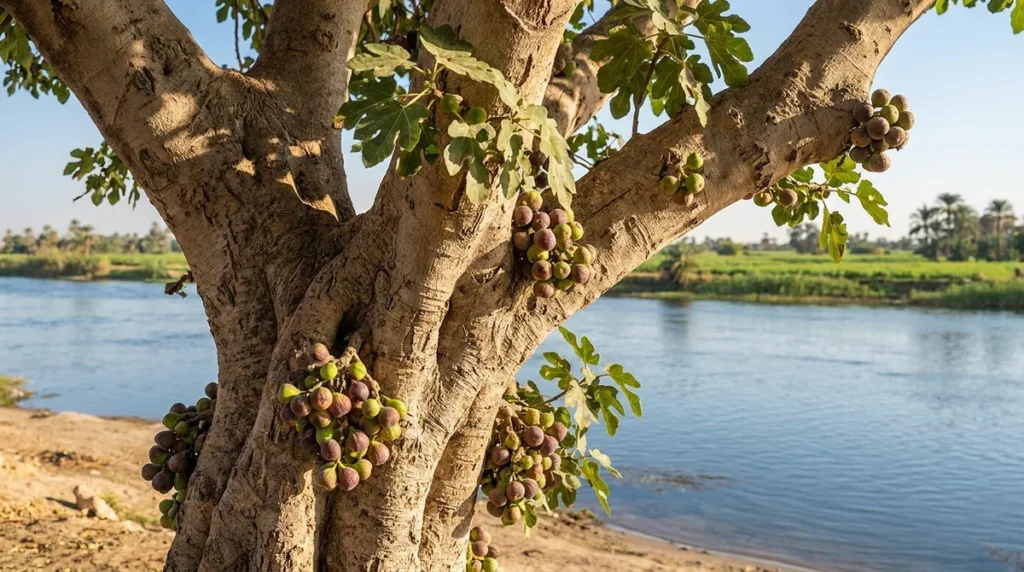
The sycamore fig is Ficus sycomorus, an African fig tree that carries figs directly on its trunk. It is the sycamore of the Bible and of ancient Egypt — and it is not related to the American sycamore (Platanus occidentalis) or to the British "sycamore" (Acer pseudoplatanus, which is a maple).
Three unrelated trees share one English name, and this is the one that owned the name first. Looking for the big white-barked shade tree of North American riverbanks? That is the American sycamore. Arrived from the UK or Ireland? Your sycamore is a maple, and the difference is laid out in our comparison of sycamore and maple. This page is about the fig.
- What exactly is a sycamore fig?
- The figs grow straight out of the trunk
- Why Egyptian farmers cut the fruit with a knife
- Why Egypt buried its dead in sycamore fig wood
- In the Hebrew Bible it is the cheap tree, not a symbol of prosperity
- How the name ended up on three trees
- Telling the three sycamores apart
- Can you actually grow one?
- Is the fruit worth eating?
What exactly is a sycamore fig?
Ficus sycomorus L. is a fig in the family Moraceae, subgenus Sycomorus — a true fig, a close relative of the edible fig Ficus carica. It is native to sub-Saharan Africa and southern Arabia, and it has been cultivated in Egypt and the Levant for well over 3,000 years.
It grows 30–65 feet (9–20 m) tall, with exceptional trees reaching about 100 feet (30 m). The crown spreads 30–50 feet (9–15 m) and is very often wider than the tree is tall. Growth runs about 3–5 feet (1–1.5 m) a year in a frost-free climate, and a tree takes 20–50 years to reach its final form.
Kew's description gives you the field impression in a sentence: a short trunk with spreading main branches, grey-brown flaking bark that turns yellowish on old trunks, and milky white latex in every broken twig and leaf stalk. The leaves are simple and unlobed — 3–15 cm long, alternate, with a rounded to slightly heart-shaped base. No lobes at all. That alone separates it from the other two sycamores at a glance, because both of them have deeply lobed leaves.
The figs grow straight out of the trunk
This is the feature that identifies the tree from thirty yards away. The figs are not tucked among the leaves at the branch tips, as on a common fig. They erupt in dense clusters directly from the trunk and the thick old branches. Botanists call it cauliflory.
Kew's account is precise about how it happens: figs sit singly or in pairs in the leaf axils, or on leafless branchlets up to 10 cm long, or on branched leafless branchlets up to 20–35 cm long borne on older branches and down the trunk itself. Those leafless branchlets are what produce the trailing bunches you see photographed on the bare bark. Each fig — properly a syconium — is 2–5 cm across, ripening from pale green to yellowish or reddish.
Set against the other two trees, the fruit ends the argument. Platanus occidentalis carries hard, dry spherical seed heads made of hundreds of achenes — never samaras. Acer pseudoplatanus carries paired winged samaras, the helicopters. Neither of them puts fruit on its trunk.
Why Egyptian farmers cut the fruit with a knife
In its native African range, Ficus sycomorus is pollinated by its own wasp, Ceratosolen arabicus, which enters the fig, pollinates the long-styled flowers and lets the tree set viable seed. Egypt is the interesting case: the pollinating wasp was historically absent or scarce there, so Egyptian trees could not reproduce sexually. Without pollination, a fig tree normally drops its immature syconia.
Two things kept the crop coming. First, a non-pollinating wasp, Sycophaga sycomori, lays eggs in the figs, and that oviposition triggers development of the fruit even though no seed is produced. Second — and this is the famous part — growers gashed the young figs by hand a few days before harvest. The wound releases ethylene, which accelerates ripening and turns a small hard fig into a soft sweet one. J. Galil documented the practice in Economic Botany in 1968, and the same gashing scars have been identified on desiccated figs recovered from Egyptian contexts.
The practical consequence is easy to miss and it explains a lot: because Egyptian trees produced no seed, they were propagated vegetatively — a branch broken off and planted. Egyptian sycomore groves were effectively clones, maintained by cutting for millennia.
This is almost certainly the job behind Amos 7:14, where the prophet calls himself a herdsman and — in the Hebrew — boles shiqmim. The verb behind boles carries the sense of nicking or piercing sycamore figs, and the phrase appears only once in the Hebrew Bible, which is why English translations wander between "dresser," "tender," "gatherer" and "pincher" of sycamore figs. Treat it as the standard reading rather than a settled one: the philology points at the gashing, but it rests on a single verse.
Why Egypt buried its dead in sycamore fig wood
Egypt had almost no good native timber. Cedar came by ship from Lebanon and was expensive, so sycomore fig — light, workable and remarkably durable in a dry climate — became the everyday structural and funerary wood for people who could not buy imported cedar. Coffins, coffin boxes and carved funerary figures in sycomore fig wood survive in the Metropolitan Museum of Art and the British Museum among others.
The wood choice was not only economic. The sycomore was the tree of Hathor, "Lady of the Sycamore" — an epithet also attached to Nut and to Isis. Tomb paintings show a goddess emerging from the trunk of a sycomore to hand water and fruit to the deceased, the image known as the tree goddess. The Book of the Dead places twin turquoise sycomores at the point on the eastern horizon where the sun rises. Being enclosed in sycomore wood meant being returned to the mother goddess, which is a rather more specific idea than the generic "tree of life" you will find repeated online.
We treat what this tree has meant to different cultures in our guide to sycamore tree symbolism, and the tangle of names and traditions in sycamore tree history, folklore and cultural relevance.
In the Hebrew Bible it is the cheap tree, not a symbol of prosperity
This is where most of the search results go wrong. Devotional pages routinely present the biblical sycamore as an emblem of abundance and blessing. Read the verses and it is the opposite: the sycamore is the yardstick of the ordinary, the cheap timber of the lowlands.
- 1 Kings 10:27 — Solomon made silver as common in Jerusalem as stones, "and cedar as plentiful as sycamore in the Shephelah." The sycamore is the thing everyone already has: the baseline the luxury item is measured against.
- Isaiah 9:10 — "The bricks have fallen, but we will rebuild with cut stone; the sycamores have been cut down, but we will put cedars in their place." It is a boast about trading up. Mud brick and sycamore are the poor materials; dressed stone and cedar are the rich ones.
- Psalm 78:47 — hail on the vines, frost on the sycamores. A telling detail, because frost is exactly what kills this species.
The sycamore grew in the Shephelah, the foothills between the coastal plain and the Judean hills — Amos's own country.
And the tree Zacchaeus climbed in Luke 19:4 is this one. The botany fits the story exactly: a low, wide-spreading crown on a short trunk is a climbable tree, which a cedar or a date palm is not. We keep the reading of the passage itself on a separate page — see Zacchaeus in the sycamore tree and the biblical references for the exegesis. What matters here is that the tree in Jericho was Ficus sycomorus, not the American tree that shares the name.
How the name ended up on three trees
"Sycamore" comes through Latin sycomorus from Greek sykomoros — literally "fig-mulberry," from sykon (fig) and moron (mulberry), possibly reshaped from the Hebrew shiqmah. It meant this tree and only this tree.
English then lent it out twice. In the 1500s it was applied to the European maple Acer pseudoplatanus, and by the early 1800s to the North American Platanus occidentalis, both on the strength of a broad, shady, vaguely fig-like leaf. Neither borrowing has any botanical justification, and both are now permanent. Our guide to the sycamore tree types sets all of them side by side.
Telling the three sycamores apart
| Ficus sycomorus | Platanus occidentalis | Acer pseudoplatanus | |
|---|---|---|---|
| Family | Moraceae (fig) | Platanaceae (plane) | Sapindaceae (maple) |
| Leaf | Simple, unlobed, alternate | 3–5 shallow lobes, alternate | 5 palmate lobes, opposite |
| Sap | White latex | Clear | Clear |
| Fruit | Figs on trunk and old branches | Dry spherical seed heads | Paired samaras |
| USDA zones | 9b–12 | 4–9 | 4–7 |
| Called "sycamore" in | The Bible, Egypt, Africa | North America | Britain and Ireland |
Can you actually grow one?
In almost all of the United States, no — and saying so is more useful than pretending otherwise. Ficus sycomorus is hardy in USDA zones 9b–12 and is only really dependable from zone 10 up. It does not tolerate freezing. That leaves the frost-free fringes: south Florida, Hawaii, the lower Rio Grande Valley and the warmest coastal pockets of Southern California. Everywhere else it is a container plant that will need overwintering indoors, or nothing at all.
Where it does grow, it asks for well-drained loam at pH 6–8 and is drought-tolerant once established. Give it 30–50 feet (10–15 m) of clearance from buildings, paving and drains: it is a fig, with the aggressive rooting habit that implies, and the milky latex stains hard surfaces. It also needs room for a crown that will end up broader than the tree is tall.
The honest framing: for most readers this is a cultural and historical tree, not a landscaping option. If you want a large fast shade tree for a temperate garden you want the American sycamore, and the constraint that decides it is space — see our figures on managing sycamore tree roots near structures before you plant anything in this family.
Is the fruit worth eating?
The figs are edible and are eaten fresh or dried across Africa, where the tree is also one of the most important wildlife food sources going: birds, fruit bats, baboons, monkeys, bushpigs, kudu, giraffe and elephant all feed on it.
Accounts of the flavor vary — from insipid to distinctly sweet and aromatic — which is unsurprising for a tree propagated by cutting and ripened by gashing. What is not in dispute is that no commercial fig industry was ever built on it. That belongs to Ficus carica, the common fig of Mediterranean orchards and supermarket shelves, which is a smaller, deciduous, hardier tree bearing figs among its leaves rather than on its trunk. If you have eaten a fig, you have eaten Ficus carica. The sycamore fig is the one people ate when it was there, and it was there in enormous quantity — which brings us back to why the Hebrew Bible used it as the measure of the commonplace.
Recommended: