
Sycamore vs. Oak, Birch and Cottonwood: 3 Ways to Tell
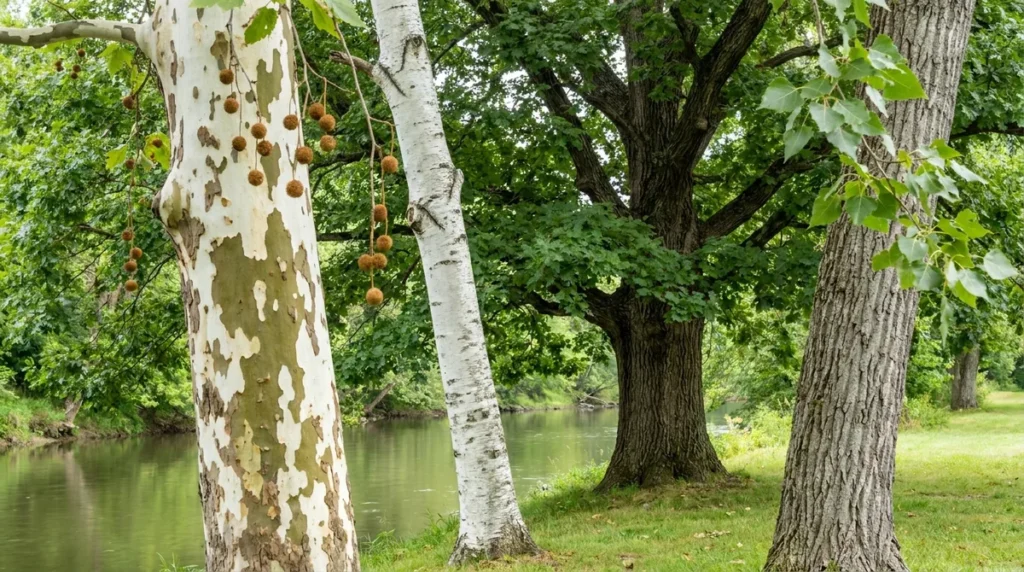
Acorns mean oak. Cottony fluff drifting in early summer means cottonwood. White bark peeling off in thin horizontal strips means birch. An American sycamore does none of the three: it hangs hard, spherical seed balls on long stalks and holds them all winter.
One note before the details. "Sycamore" names three unrelated trees, and this page is about the American sycamore, Platanus occidentalis — not the British "sycamore" (Acer pseudoplatanus, which is really a maple) and not the sycamore fig (Ficus sycomorus) of the Bible and ancient Egypt. If you are in the UK, the tree you call a sycamore is the maple, and your comparison is a different one entirely.
These three confusions have three different causes, which is why one checklist never settles them. With birch you are misreading the bark; with cottonwood, the habitat and silhouette; with oak, the leaf.
Start here: the four trees at a glance
| Trait | American sycamore | Oak | Birch | Eastern cottonwood |
|---|---|---|---|---|
| Fruit | Hard, spherical seed balls on a long stalk; usually one per stalk; hang on all winter | Acorns | Small cone-like catkins that crumble apart | Cottony seed fluff in early summer (female trees only) |
| Leaf shape | Palmately lobed, 3-5 shallow lobes radiating from one point; 4-9 in (10-23 cm) wide, often wider than long | Pinnately lobed along a central midrib; longer than wide | Small oval, pointed, doubly toothed; no lobes at all | Triangular (deltoid), coarsely toothed; no lobes |
| Leaf stalk | Base swollen and hollow, capping the bud underneath | Ordinary round stalk | Ordinary round stalk, short | Flattened side to side, so the leaf trembles in the faintest breeze |
| Bark | Smooth, shedding irregular jigsaw plates; white to cream high in the crown | Furrowed and ridged into plates or blocks; never smooth, never patchy-pale | Peels in thin horizontal papery strips, with dark horizontal lenticels | Smooth greenish-gray when young; deeply furrowed and ashy gray with age |
| Mature size | 75-115 ft (23-35 m), crown 65-100 ft (20-30 m) | 80-100 ft (24-30 m) for white oak | 40-70 ft (12-21 m) for paper birch | 75-100 ft (23-30 m) |
Two rows do nearly all the work: fruit and bark. One row people expect to help does not — leaf arrangement. All four carry their leaves alternately along the twig. Alternate-versus-opposite only rules out maples, which is why it matters in the sycamore and maple comparison and not here.
Sycamore vs. oak: the lobes point in different directions
This is the most-searched of the three and the fastest to close. If the tree drops acorns, it is an oak. Nothing in the genus Platanus produces an acorn.
With no fruit on the ground, the lobes settle it. A sycamore leaf is palmately lobed: three to five broad, shallow lobes fanning out from a single point at the top of the stalk, like fingers from a palm. An oak leaf is pinnately lobed — the lobes come off a central midrib along the length of the blade, and they are cut far deeper. White oak (Quercus alba) carries roughly six to eight of them with rounded tips; the red oak group has bristle-tipped lobes. Either way the leaf is longer than wide, while a sycamore leaf is typically wider than long and runs 4 to 9 inches (10-23 cm) across.
Bark is the giveaway from fifty yards. Oak bark stays furrowed and ridged for life: white oak breaks into flat, narrow, light ashy-gray plates, red oaks into darker vertical ridges. It flakes, but it never sheds the way a sycamore does and never leaves smooth pale patches. A sycamore's upper trunk and limbs go chalk-white and smooth — which is why sycamore bark is the most reliable feature the tree has.
In winter, look at the twig tips. Oaks carry a cluster of buds at the end of each twig, a diagnostic character across the whole genus. A sycamore carries one cone-shaped bud ringed by a leaf scar that circles all the way around it, because the base of the fallen leaf stalk was hollow and sat over the bud like a cap. That hollow petiole is a genus trait, not a species trait: it says "this is a Platanus," not "this is an American sycamore." For that last step, see sycamore versus London plane.
Sycamore vs. birch: the white bark trap
This is the most common mistake made at a distance, and always the same one: two pale trunks judged from a car window. The tell is not the whiteness. It is how the white comes off.
Paper birch (Betula papyrifera) peels in thin, papery horizontal strips that curl away from the trunk, and the bark is stamped with dark, narrow horizontal lenticels — slit-like pores running around the trunk like dashes. A sycamore has no lenticel dashes and no papery curl. It sheds irregular plates that leave a camouflage patchwork of cream, olive, tan and gray, whitest and smoothest highest up.
The leaves are not close. A birch leaf is a couple of inches long, oval, sharply pointed, doubly toothed and completely unlobed. A sycamore leaf is a broad, shallowly lobed hand up to 9 inches wide. Size closes what is left: paper birch matures at 40 to 70 ft (12-21 m), often as a multi-stemmed clump, against 75 to 115 ft (23-35 m) for a sycamore. Unlike the two comparisons below, here the scale really does discriminate.
One correction worth having, because almost no one makes it: the white-barked birch is a northern tree and is generally not the birch growing beside a sycamore. In eastern bottomlands and southern riverbanks — sycamore country — the birch you meet is river birch (Betula nigra), 30 to 60 ft, in the same floodplains, and it also exfoliates. But its bark curls cinnamon-brown and salmon over a pinkish-orange inner layer, never chalk white. On a riverbank, "peeling bark" alone proves nothing.
Sycamore vs. cottonwood: same riverbank, two different leaves
This is the hardest of the three. Eastern cottonwood (Populus deltoides) and American sycamore are both very large, very fast-growing bottomland trees of the eastern United States, and they often stand within sight of each other on the same floodplain. Habitat, height and silhouette will not separate them.
The leaf stalk will. A cottonwood's petiole is flattened on a plane perpendicular to the blade, so the triangular leaf catches the smallest air movement and trembles — the same trick aspens use, and the reason a cottonwood is audible before it is visible on a breezy day. The blade is deltoid, coarsely toothed and unlobed. A sycamore petiole is round, swollen and hollow at the base, and the lobed leaf hangs comparatively still.
The seeds behave in opposite ways. A cottonwood releases masses of cottony, wind-borne fluff in early summer. A sycamore produces achenes packed into a hard spherical head that ripens brown in fall, hangs on all winter and breaks apart in spring. Note carefully: a sycamore does not produce winged helicopter seeds. Those belong to maples.
The cotton also hides a real difference in biology, and nurseries exploit it. Cottonwood is dioecious: male and female flowers sit on separate trees, so only females make cotton, and all-male "cottonless" clones are sold to avoid the mess. Sycamore is monoecious — both flower types on the same tree. There is no male or female sycamore, and therefore no "female-free" cultivar that will spare you the seed balls. Anyone selling you one is selling you a fiction.
Bark helps only on mature trunks. Young cottonwood bark is smooth and greenish-gray, the one moment it resembles a young sycamore; with age it turns ashy gray and splits into long, deep, interconnecting furrows. When there is no fruit, check several seed stalks rather than one: a sycamore usually carries a single ball per stalk, occasionally two. More on all of it in the sycamore tree identification hub and the American sycamore profile.
Which of these four can you actually plant near a house?
Most of these searches end here, so here is the honest ranking. Oak is the good neighbor: strong-wooded, deep-rooted, long-lived and slow enough that it will not surprise you. The price is time.
Birch is the one that fits a suburban lot, at 40 to 70 ft with a modest crown. But it is shallow-rooted and stress-sensitive, it is the preferred target of the bronze birch borer, and it is short-lived — an average around 80 years, and far less in warm zones. Plan on replacing it.
Cottonwood is a poor choice near any structure, and extension sources say so plainly. Its speed makes it weak-wooded and brittle, so it sheds limbs in wind and ice, and its shallow roots are known to buckle sidewalks and invade sewer and septic lines. The failure mode is falling wood and broken pipes.
Sycamore is the most demanding of the four, and this site is not going to soften that. Keep it a minimum of 40 ft (12 m) from foundations, walls and the property line — 60 ft (18 m) on clay soil or with a basement — and 50 ft (15 m) from sewer, drainage and septic runs. Sidewalks and retaining walls want 20 to 26 ft (6-8 m), and the pavement will still lift eventually. Never plant one under an overhead line.
The mechanism matters, because "sycamore roots break houses" is not quite true and leads to the wrong precautions. The roots do not push a sound foundation apart. The real damage is the tree drying out clay soil, which causes differential settlement under the footings, and roots finding a pipe joint that had already cracked. That is covered properly in our guide to managing sycamore roots near structures. On a large open property the sycamore is one of the finest shade trees in North America — the mistake is putting a 100-foot crown on a 60-foot lot.
If it is none of these four
Two trees fool people more often than birch or cottonwood ever will. If the leaves grow in opposite pairs and the seeds are winged helicopters, you have a maple: see sycamore vs. maple. And if the bark peels but reads olive and khaki rather than chalk white, and the seed stalks carry two balls apiece, you are almost certainly looking at a London plane — sycamore vs. London plane. For anything else, start at the identification hub or the overview of sycamore tree types.
Recommended: