
Sycamore Leaf Identification: Which Tree Do You Have?
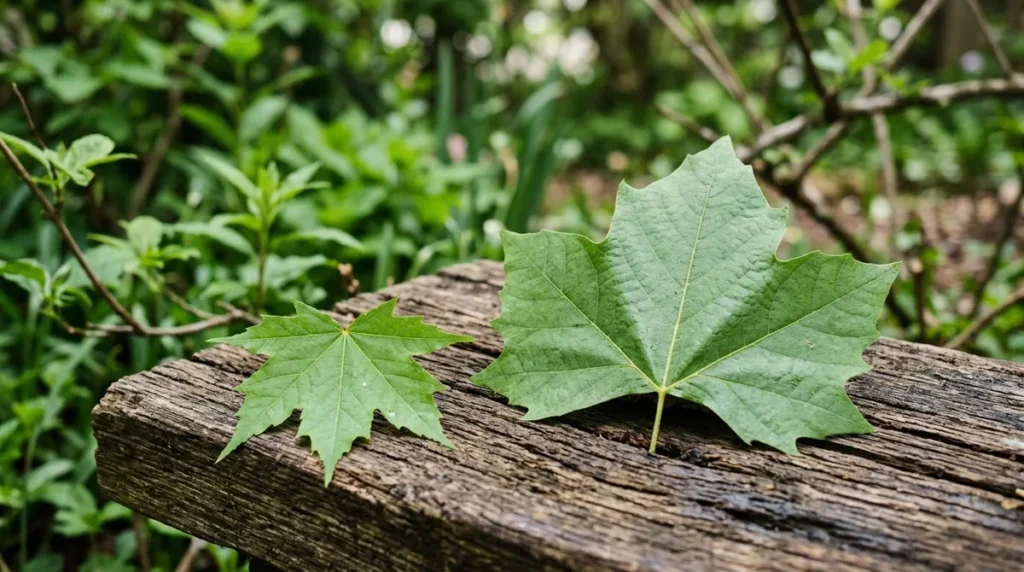
If you have a leaf in your hand and you want to know whether it came from a sycamore, start with one question: does the leaf grow singly along the twig, or in facing pairs? Alternate means you are holding a true sycamore, Platanus. Opposite means you are holding a maple. That single check separates the two trees people mix up most.
The reason this is confusing at all is that "sycamore" is not one tree. It is a name that three unrelated species share:
- Platanus occidentalis — the American sycamore, the tree with the peeling white bark that grows along rivers across the eastern United States.
- Acer pseudoplatanus — the sycamore of Britain and Ireland. It is a maple, not a plane tree, and it is not related to the American sycamore at all.
- Ficus sycomorus — the sycamore fig of Africa and the Middle East. It is a fig, and it is the tree of the Zacchaeus story.
Their leaves are not variations on a theme. They are three genuinely different leaves. Here is how to tell which one you picked up.
- Step one: check how the leaf sits on the twig
- Step two: the leaf stalk that swallows the bud
- Step three: look at the base of the blade
- The three sycamore leaves side by side
- A three-step key you can run in the field
- Sycamore leaf vs maple leaf: why they look so similar
- Sycamore leaf vs London plane leaf
- Why are the leaves blotched, curled and falling in early summer?
- What color do sycamore leaves turn in fall?
- The sycamore leaf that is not lobed at all
- If you still are not sure
Step one: check how the leaf sits on the twig
Go back to the branch the leaf came from, if you can. Platanus occidentalis carries its leaves alternately — one leaf, a gap, then the next leaf on the other side, in a zigzag. Acer pseudoplatanus, like every maple, carries them opposite: two leaves directly facing each other at the same point on the twig, and two buds facing each other in winter.
This test costs nothing and it never fails. It is more reliable than counting lobes, because lobe counts overlap between the two trees and leaves on the same branch vary. If the leaves come in pairs, stop looking at plane trees.
Step two: the leaf stalk that swallows the bud
This is the trait that settles a Platanus leaf on its own, without the twig, without the bark, without the fruit.
On American sycamore the base of the petiole — the leaf stalk — is swollen and hollow, and it fits down over next year's bud like a thimble. Virginia Tech's dendrology fact sheet puts it plainly: the petiole bases encircle and enclose the buds. Snap the leaf off and you will find the bud sitting underneath, with a leaf scar that runs all the way around it in a closed ring.
No maple does this. No fig does this. If the stalk base is a hollow cap rather than a simple stem, the leaf is from a plane tree.
One honest caveat that most pages skip: this trait belongs to the genus, not to one species. London plane and California sycamore have it too. The hollow petiole tells you "this is a Platanus" — it does not tell you which Platanus. For that, see the comparison further down and our guide to the different sycamore tree types.
Step three: look at the base of the blade
Hold the leaf so the stalk points at you and look at where the blade begins.
American sycamore is truncate to cordate — cut off flat, or notched into a shallow heart. The blade is usually wider than it is long, typically 4 to 9 inches (10–23 cm) across, with three to five lobes that are broad and shallow rather than deeply cut, and coarse, widely spaced teeth. The underside is paler, with hairs along the veins.
Sycamore maple has a deeper, more decisive heart-shaped notch, five clearly separated lobes, and a leaf that is roughly as long as it is wide. The sycamore fig has no lobes at all.
The three sycamore leaves side by side
| Trait | American sycamore Platanus occidentalis | Sycamore maple Acer pseudoplatanus | Sycamore fig Ficus sycomorus |
|---|---|---|---|
| Arrangement | Alternate | Opposite (pairs) | Alternate |
| Lobes | 3–5, broad and shallow | 5, clearly cut, palmate | None — simple and entire |
| Shape and size | Wider than long, 4–9 in (10–23 cm) across | About as long as wide, 7–16 cm | Broadly oval to rounded, 3–15 cm long |
| Base of blade | Truncate to shallowly heart-shaped | Distinctly heart-shaped | Rounded to narrowly heart-shaped |
| Margin | Coarse, widely spaced teeth | Toothed, teeth blunt rather than drawn to fine points | Almost smooth, or finely scalloped |
| Leaf stalk | Long; base hollow, caps the bud | 5–15 cm, often red on young trees | Short, no swollen base |
| Texture | Thin, papery, hairy on the veins beneath | Firm, dark green above, paler and hairy-veined beneath | Leathery, often rough to the touch |
| Broken stalk | Clear sap | Clear sap | Milky latex |
| Fruit under the tree | Round seed balls of achenes on a stalk | Paired winged samaras — the helicopters | Figs growing straight off the trunk |
Two rows in that table are worth pausing on.
First, the hairy underside is not a discriminator. The Woodland Trust's own "look out for" line on sycamore maple is hairy leaf veins beneath — and American sycamore has pubescent veins beneath as well. Plenty of pages present hairiness as a way to tell them apart. It is not. Use the arrangement instead.
Second, the helicopters belong to the maple. Platanus occidentalis does not produce samaras. Its fruit is a spherical head of achenes hanging on a long stalk, which is where "buttonball tree" comes from. If you are finding winged seeds spinning down, you are under an Acer, and the leaf in your hand is almost certainly a maple leaf.
A three-step key you can run in the field
- 1. Arrangement. Leaves in facing pairs? → sycamore maple (Acer pseudoplatanus). Leaves single and staggered? → go to step 2.
- 2. Petiole base. Stalk base swollen and hollow, capping a bud? → a plane tree (Platanus). Stalk plain, and the broken stalk bleeds white? → sycamore fig (Ficus sycomorus).
- 3. Base of the blade and lobe depth. Broad, shallow lobes with a flat or shallow-notched base, blade wider than long → American sycamore. Deeper sinuses and a longer, more pointed central lobe → London plane.
Three checks, in that order, and you will place almost any sycamore leaf in North America or Britain. The full sequence for the rest of the tree — bark, fruit, twig, form — is in our sycamore tree identification guide.
Sycamore leaf vs maple leaf: why they look so similar
They look similar because they converged, not because they are related. Both are palmately veined and palmately lobed, both are large, and both are green. But Acer pseudoplatanus sits in the soapberry family and Platanus occidentalis in a family of its own, Platanaceae, with no close living relatives.
In practice you have three quick tells: the pairing of the leaves, the samaras, and the leaf stalk. On younger sycamore maples the stalk is often noticeably red, which American sycamore never is. We go through the whole comparison, including bark and habit, in sycamore vs maple.
Sycamore leaf vs London plane leaf
This is the harder one, because London plane (Platanus × acerifolia) is a hybrid of the American sycamore and the Oriental plane, and it inherited most of the family traits — including the hollow petiole.
The leaf difference is real but relative. London plane has deeper sinuses between the lobes and a central lobe that tends to be longer than it is wide, giving it a sharper, more star-shaped outline. American sycamore's central lobe is usually broader than long, so the whole leaf reads as rounder and squatter.
If you can see the fruit, use it instead — it is a cleaner test than the leaf. American sycamore normally carries one seed ball per stalk; London plane usually carries two. Full breakdown in sycamore tree vs London plane.
Why are the leaves blotched, curled and falling in early summer?
Brown or tan lesions running along the veins, shrivelled young shoots and a thin crown in late spring are the signature of sycamore anthracnose (Apiognomonia veneta). It is by far the most common thing wrong with an American sycamore leaf, and it hits P. occidentalis harder than London plane.
The pattern matters for diagnosis: anthracnose lesions follow the veins, rather than forming round spots scattered across the blade. The fungus overwinters in bark cankers and infects new leaves in spring, and it is worst when the two weeks after leaf-out stay cool — below about 55 °F (13 °C) on average. A cold, wet May means a badly blotched tree; a warm one means the tree sails through.
Healthy trees usually releaf and recover once the weather turns. Repeated bad years weaken them. See sycamore tree diseases for treatment thresholds, and why your sycamore is dropping leaves if the drop is happening outside spring.
What color do sycamore leaves turn in fall?
American sycamore browns. It does not color.
This disappoints people every autumn, so it is worth saying without hedging: Platanus occidentalis foliage goes from green to a dull yellow and then to brown, and the leaves usually drop looking tired rather than bright. It is not a fall-color tree, and nothing you do to the soil will make it one. What the tree offers instead is the winter silhouette — white upper bark against a grey sky — which is the reason it gets planted in the first place.
Sycamore maple does slightly better, turning yellow through orange and occasionally red before dropping. Neither is in the league of a red maple, and neither should be chosen for autumn display.
The sycamore leaf that is not lobed at all
If your leaf is oval, leathery, has no lobes, and the broken stalk beads with white latex, you are holding Ficus sycomorus — and you are almost certainly not in North America or northern Europe. This is the sycamore of Egypt and the Levant, the tree Zacchaeus climbed in Luke 19:4, and it is a fig.
Its leaves are broadly oval to almost round, roughly 3–15 cm long, rounded or slightly heart-shaped at the base, with an edge that is nearly smooth. The fruit is unmistakable and appears nowhere else in this comparison: figs borne directly on the trunk and on the thick branches, in clusters. If you are trying to reconcile a biblical passage with the tree in your yard, start with Zacchaeus and the sycamore in the Bible — the tree in that text is not the one growing in Ohio.
If you still are not sure
Take the leaf back to the tree and look up. Bark settles most cases in seconds: American sycamore sheds in plates and goes chalk-white in the upper crown, which no maple and no fig does. Then look at the ground for fruit — seed balls, samaras or figs — and count how many balls hang from a single stalk. The species profile in our American sycamore guide walks through every one of those checks with the measurements.
Recommended: