
Sycamore Tree Through the Seasons: A Month-by-Month Care Calendar
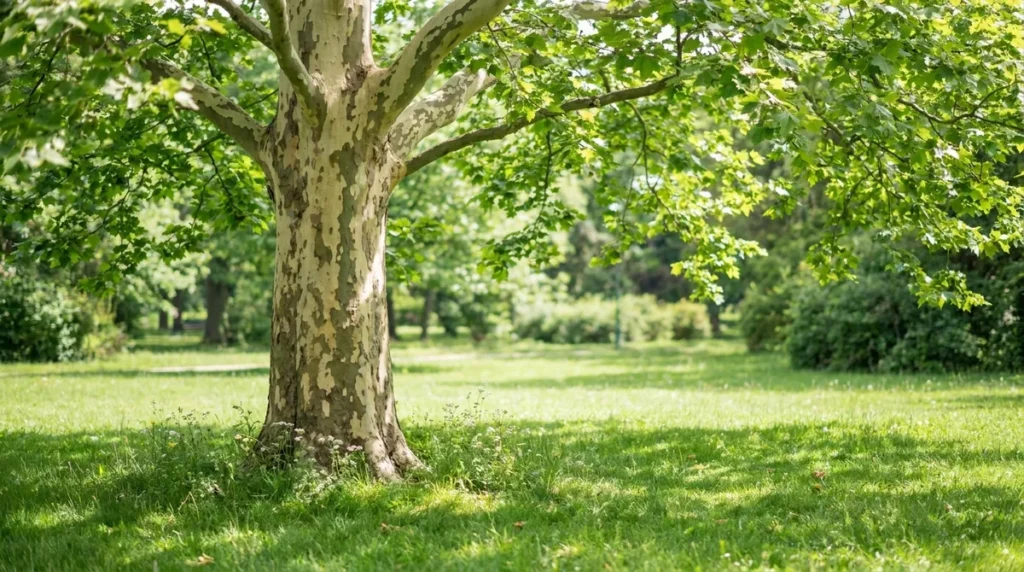
A sycamore's year comes down to four jobs, one per season: prune it in winter, leave it alone in spring, water it in summer, and clean up after it in fall. Everything else is optional. This calendar is for Platanus occidentalis, the American sycamore — the tree with the white peeling crown and the round seed balls.
Two other trees answer to the name. Platanus × acerifolia, the London plane, follows almost the same calendar and takes hard pruning better. Acer pseudoplatanus, the tree the British call sycamore, is a maple: winged samaras, not seed balls. Ficus sycomorus, the sycamore fig of Egypt and of Luke 19:4, has no dormant season and survives only in USDA zones 9b-12. If you are looking at a large temperate shade tree in North America, the calendar below is yours; the rest of the maintenance program is in our sycamore tree care hub.
- Winter: the tree is bare, and that is your only pruning window
- Spring: your sycamore is not dead, it is just late
- Summer: water is the real limit, not heat
- Fall: a great deal of leaf litter, and no show at the end of it
- The sycamore year, month by month
- The honest warning: this tree makes four separate messes
- Does this calendar fit the other two sycamores?
Winter: the tree is bare, and that is your only pruning window
What the tree is doing. Nothing above ground. It is dormant, and it is also at its most identifiable: with the leaves gone the upper limbs read bone-white against flat light, and last summer's seed balls hang on through the cold. One ball per stalk (occasionally two) means American sycamore; two or three per stalk means London plane, so check several stalks before deciding. The mechanism behind the pale crown is in our guide to sycamore tree bark.
What you do. Prune. Penn State Extension is specific about this tree: prune sycamores and London planes only during December and January, and only when the weather is dry. The reason is canker stain of plane (Ceratocystis platani), which enters through fresh wounds and travels between trees on contaminated saws. Nothing controls it chemically, so timing and sanitation are the whole strategy. Disinfect tools between trees, not between jobs.
This is also when you cut out twigs killed by last spring's anthracnose, since the fungus overwinters in those cankers and in fallen leaves. On a large tree you will not reach much of it, which is why the fall cleanup matters more. If your sycamore is kept deliberately small on a short cycle, that work belongs in this window too — see pollarding and coppicing sycamore trees.
What not to do. Do not prune on a wet day. Do not use wound paint or sealant: a contaminated brush spreads canker stain spores more efficiently than a saw. And do not postpone structural pruning into spring — once the buds move, the window has closed.
Spring: your sycamore is not dead, it is just late
What the tree is doing. Leafing out late, and this is the most common panic in the species. American sycamore leafs out later than most of its neighbors, so there is a stretch of weeks when everything else on the street is green and your tree is a bare white skeleton. The flowers open at the same time as the leaves and are small, greenish and easy to miss. Wait until the surrounding trees are in full leaf before you conclude anything.
Last year's fruit also lets go now. The seed balls that hung on all winter break apart and come down as a shower of loose achenes and fiber — so if you were expecting the mess in October, you had the wrong month. Those achenes are packed with fine hairs that irritate eyes, nose and throat mechanically rather than as an allergen, which is why antihistamines do nothing for them. Gloves and eye protection if you are shredding the debris.
The disease that defines spring. Sycamore anthracnose (Apiognomonia veneta) is severe when the average daily temperature during leaf-out and for the two weeks after stays below about 55 °F (13 °C). In a cold, wet spring it kills expanding shoots and buds and produces brown lesions running along the leaf veins rather than as scattered round spots. A vigorous sycamore then pushes a second flush and is back in leaf by midsummer; that cycle is normal, and it is repeated bad years that wear a tree down. Symptoms and lookalikes are in sycamore tree diseases, and if yours is losing foliage outside this pattern, start at why is my sycamore tree dropping leaves.
What not to do. Do not prune now. Do not spray a mature tree in reaction to anthracnose you can already see: treatment is preventive, and the tree usually recovers without it. And do not reach for fertilizer as a cure for a defoliated sycamore — the problem is fungal and weather-driven, not nutritional.
Summer: water is the real limit, not heat
What the tree is doing. Growing harder than almost anything you can plant — roughly 60-90 cm a year (2-3 feet), and up to 1.8 m a year on deep, moist, alluvial soil — and drinking accordingly. This is a bottomland tree. It shrugs off temporary flooding and holds USDA zones 4-9, so cold is not its limit. Prolonged drought is.
What you do. Water deeply and infrequently. Wet the whole root zone out to and beyond the edge of the canopy, then let the surface dry before the next soak; a daily sprinkle keeps roots shallow and does nothing for a tree this size. Mulch over the root zone, kept clear of the trunk. Newly planted and recently moved trees need this through their first several growing seasons.
Watch for the drought signature described by UF/IFAS: leaves that scorch, go crisp and curl to a reddish brown, followed by stress cankers on the limbs. Scorch on a mature sycamore in August is a watering problem until proved otherwise.
Pests. Sycamore lace bug (Corythucha ciliata) feeds on the undersides of the leaves and produces fine white stippling that turns bronze as populations build. It runs several generations through the summer and can partly defoliate a tree by late summer, but on an established shade tree the damage is cosmetic and arrives close enough to natural leaf drop that treatment is rarely justified. Check leaf undersides before you diagnose anything: sycamore tree pests.
Bark plates come off most heavily during the growing season, when the trunk is expanding fastest and the rigid outer bark cannot follow it. Plates on the lawn in midsummer are a growth report, not a symptom.
What not to do. Do not top the tree to control its size, and do not try to solve with pruning what siting should have solved: a sycamore belongs at least 12 m (40 feet) from foundations and 15 m (50 feet) from sewer and drain lines.
Fall: a great deal of leaf litter, and no show at the end of it
What the tree is doing. Shutting down without a display. Sycamore leaves go dull yellow and then brown, and extension descriptions of the species agree the fall characteristic is not showy. If you want color, this is not the tree; if you want a white trunk in January, it is.
The volume is the real story. Leaves are 10-23 cm (4-9 inches) across on a crown that can spread 20-30 m (65-100 feet). The litter is coarse, bulky, slow to break down, and lands over a footprint that will include your neighbor's yard.
What you do. Rake, and understand that raking is not housekeeping here. Fallen leaves and twigs carry the overwintering inoculum of sycamore anthracnose, so clearing them is the cheapest control available on a tree far too large to spray.
Planting and moving. Fall is a reasonable window for putting container-grown stock in the ground in much of the range. Moving an established sycamore is a different question, and the honest answer runs against the usual advice: Platanus appears on nursery fall-digging-hazard lists, among the species whose roots regenerate slowly after being cut. Iowa State Extension points the same way — the dormant season is the window, early spring is usually the best part of it, and bare-root material should always move in early spring. If you can wait until spring, wait. Method and root-ball sizes: transplanting a sycamore tree.
What not to do. Do not leave blighted litter under the tree over winter, and do not start pruning the moment the leaves are down — wait for the dry dormant window.
The sycamore year, month by month
Dates suit USDA zones 4-9 in the eastern United States: shift two to three weeks later in the north, earlier in the south.
| Month | What the tree is doing | Your job |
|---|---|---|
| December | Fully dormant; seed balls hanging | Prune, dry days only, tools disinfected between trees |
| January | Dormant; white crown at its most visible | Finish pruning; remove anthracnose-killed twigs; inspect the lower trunk for sunken cankers |
| February | Buds still closed | Last call for pruning in mild zones; choose planting positions and measure the distances |
| March | Last year's seed balls break apart and fall | Clear the fruit debris; gloves and eye protection if shredding |
| April | Leafing out late; small greenish flowers open with the leaves | Wait. Do not diagnose a bare sycamore this month |
| May | Anthracnose shows if the spring was cool and wet | Rake blighted leaves and shoots; water; expect refoliation |
| June | Rapid shoot extension | First deep soak of the dry season; top up mulch, kept off the trunk |
| July | Peak growth and peak water use | Deep, spaced watering; check for scorched leaf margins |
| August | Lace bug populations peak; drought stress appears on dry sites | Keep watering; check leaf undersides before treating anything |
| September | Growth slows; fruit ripens brown | Plant container stock; hold off on moving established trees |
| October | Leaves turn dull yellow to brown; drop begins | Start the leaf cleanup |
| November | Leaf drop finishes; fruit stays on the tree | Finish sanitation; assess branch structure now the crown is bare |
The honest warning: this tree makes four separate messes
Most seasonal guides count one cleanup a year. A sycamore gives you four: bark plates through the growing season, blighted leaves and dead shoots in late spring after a bad anthracnose year, the main leaf fall in autumn, and the disintegrating seed balls in early spring.
That is the trade for the trunk and the shade, and it is the most common regret among people who planted one close to a house, a pool or a driveway. If the schedule above does not fit your site, the problem is the siting, and no amount of seasonal care will fix it.
Does this calendar fit the other two sycamores?
London plane shares the pruning window and the canker stain risk exactly — the Penn State recommendation names both trees. It grows more slowly, 30-60 cm a year, and tolerates hard cutting better, which is why street pollarding is done on planes.
Sycamore maple is a maple, and its year diverges in autumn: paired winged samaras ripen at the end of summer and fall through autumn, when their concentration of hypoglycin A — the compound behind atypical myopathy in horses — is highest. Its spring seedlings carry it too. If you keep horses, that is a hazard with no equivalent in Platanus.
Sycamore fig has no place in this calendar: a frost-tender African fig for zones 9b-12 that fruits directly from its trunk, and in most of the United States a subject for reading rather than for planting.
Get the winter pruning window and the summer watering right, and an American sycamore with room around it is close to maintenance-free. Almost everything that goes wrong with it is either a spring fungus it will outgrow or a siting decision made years earlier.
Recommended: