
Sycamore Tree Bark: Why It Peels and What It Tells You
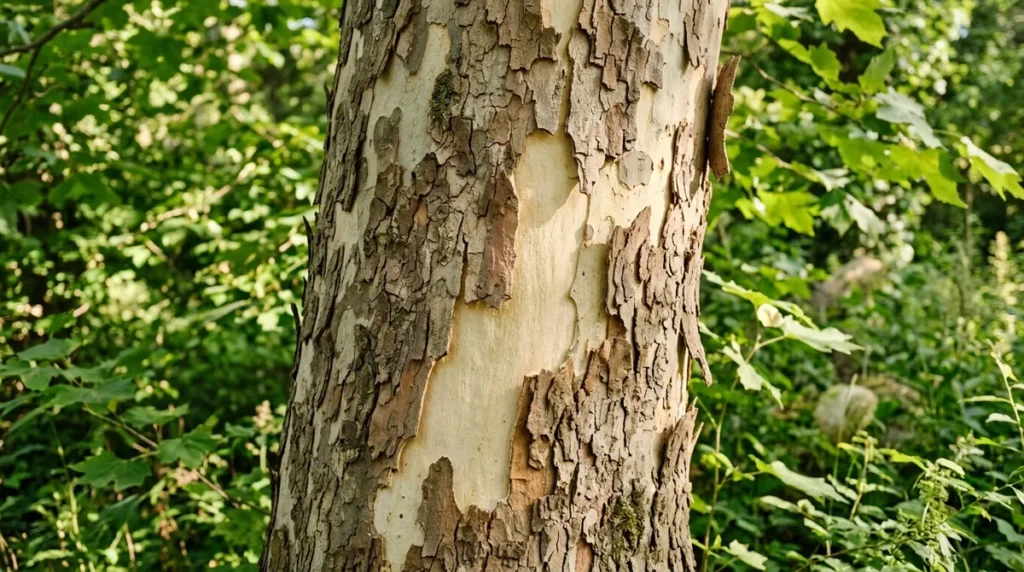
If your sycamore is dropping plates of bark on the lawn, it is almost certainly healthy. Shedding bark is not a disease and not a symptom: it is how the tree grows. Sycamore bark is rigid and cannot stretch around a trunk that keeps expanding, so the tree throws it off.
This page is mainly about Platanus occidentalis, the American sycamore. It also covers the two trees that share the name: Platanus × acerifolia, the London plane, the hybrid planted along most city streets, and Acer pseudoplatanus, the tree the British call sycamore, which is not a plane tree at all but a maple. Bark is the fastest way to separate the three.
- What does sycamore bark actually look like?
- Why does sycamore bark peel off?
- Why is the top of the tree white and the base brown?
- When is bark loss actually a problem?
- Using bark to tell the three "sycamores" apart
- American sycamore or London plane? Bark gets you halfway
- A tree planted for its bark, not its flower
- Do you need to clean up the fallen bark?
- Quick check: is your sycamore's bark telling you anything?
What does sycamore bark actually look like?
On an American sycamore, the outer bark is thin and brittle and comes away in irregular curling plates, leaving a mottled patchwork behind. The exposed inner bark is white to cream, mixed with tan, gray and a soft olive green, so the trunk reads as camouflage rather than as one color. In the upper trunk and the big limbs of a mature tree, the pale tones dominate to the point that the crown looks bone-white in flat winter light.
The plates are large and thin, more like flakes of dry paint than like the fibrous strips a shagbark hickory produces. They fall in the greatest numbers during the growing season, when the trunk is putting on wood fastest, and they keep coming for the whole life of the tree rather than only while it is young. Many trees with attractive bark exfoliate as saplings and then settle into a plated, furrowed adult bark. The sycamore never settles, because it never stops growing fast.
Why does sycamore bark peel off?
The mechanism is mechanical, not biological. Sycamore bark tissue lacks the elasticity that lets an oak or a beech stretch as its trunk thickens. The wood underneath keeps adding diameter, the rigid outer layer cannot follow it, and it splits and sloughs away. University of Illinois Extension puts it plainly: on an otherwise healthy sycamore, shedding bark is a sign of rapid stem growth, which is exactly what you want from this tree.
The growth figures explain the volume of debris. An American sycamore adds roughly 60-90 cm a year (2-3 feet), and up to 1.8 m a year on deep, moist, alluvial soil. It keeps that pace for decades instead of slowing after youth, on its way to a mature 23-35 m (75-115 feet). A trunk expanding that fast has to shed its jacket constantly. When people say a sycamore "sheds more than other trees," they are really observing that it grows more than other trees.
Why is the top of the tree white and the base brown?
Because exfoliation happens on the parts that are expanding fastest. Young stems and branches in the crown gain a large percentage of their girth every year, so they shed constantly and stay pale and smooth. The base of an old trunk is already enormous; each year's growth is a small fraction of that circumference, so the bark there is retained instead of thrown off. Retained bark thickens, darkens and cracks into rough, scaly, gray-brown to reddish-brown plates.
A mature American sycamore therefore looks like two different trees stacked on top of each other: a dark, furrowed, unremarkable base and a white, smooth, unmistakable crown. Virginia Tech's dendrology fact sheet describes the same split: mottled brown, green, tan and white bark, with older stems gray-brown and scaly.
The practical consequence matters if you are trying to name a tree: judge a Platanus by its crown, not by its trunk at eye level. Standing at the base of a big sycamore, you are looking at the least diagnostic part of it. Step back far enough to see the upper limbs against the sky. That is the single most useful habit in sycamore tree identification, and it costs nothing.
When is bark loss actually a problem?
Location, and what is underneath. Bark peeling in the crown and upper trunk is the tree working normally. Bark sloughing off the lower trunk of a mature tree is worth investigating, because that is the zone where a healthy sycamore keeps its bark. Look for these instead of counting fallen plates:
- What the bare wood looks like. Normal exfoliation exposes firm, smooth, pale inner bark. If the wood underneath is dark, soft, damp or spongy, that is decay, not shedding.
- Sunken cankers. Elongated or lens-shaped depressions in the bark, sometimes with cracks and with orange or purple discoloration at their margins, are the signature of canker stain of plane (Ceratocystis platani), which affects both American sycamore and London plane. It spreads through wounds and contaminated pruning tools, so the prevention is dull and effective: prune in dry weather and clean your saw between trees.
- Oozing or weeping from a defined point on the trunk, rather than a dry, clean peel.
- Dieback at the periphery. Bare twig tips at the outer edge of the crown, a thinning canopy, or clusters of epicormic shoots erupting along the trunk after repeated seasons of sycamore anthracnose, which kills new shoots and buds and can defoliate the tree in a cool, wet spring. A vigorous sycamore usually refoliates by midsummer, but repeated cycles weaken it.
None of those look like ordinary shedding once you know to check the wood underneath. If you have found any of them, the next stop is our guide to sycamore tree diseases.
Using bark to tell the three "sycamores" apart
| Tree | Bark in the crown | Bark at the base | The confirming check |
|---|---|---|---|
| Platanus occidentalis American sycamore | Near-white to cream, peeling in large thin plates, with tan and olive patches | Brown to gray, scaly and furrowed on old trunks | One round seed ball per stalk |
| Platanus × acerifolia London plane | Flakes the same way, but the tones run olive, khaki and gray-brown; much less white | Darker, retained higher up the trunk | Two, sometimes three, seed balls per stalk |
| Acer pseudoplatanus Sycamore maple | Gray and smooth when young, later flaking in small irregular scales that reveal an orange-brown layer | Gray-brown, scaly, rough | Opposite palmate leaves and paired winged samaras |
The maple is the easiest to rule out. Its flaking is a matter of small scales, not broad pale plates, and the overall impression stays gray: nobody plants it for its trunk. It is also the only one of the three that produces helicopter seeds. Platanus species carry their seeds in dangling spherical heads of achenes and never produce samaras, a distinction worth internalizing because plenty of pages get it backwards. Our sycamore vs maple comparison works through the leaves, seeds and habit in full.
Two other Platanus species turn up in the same conversation. Mexican sycamore has similar pale exfoliating bark but is given away by the silvery, felted underside of its leaves, and California sycamore usually grows with a leaning or multi-stemmed trunk and carries two to seven seed balls per stalk. Both are in our overview of sycamore tree types.
American sycamore or London plane? Bark gets you halfway
This is the mix-up that matters most in towns, because most street "sycamores" in cities are not American sycamores at all: they are London planes, the hybrid that tolerates compacted, polluted, salted urban soil. Bark tone is a good first filter, since the American sycamore's crown is genuinely whiter while the London plane's runs olive and khaki, but light, age and grime all interfere with a color judgment.
The reliable confirmation is the fruit, and it works from the ground with binoculars in winter: one seed ball per stalk on the American sycamore, two (sometimes three) on the London plane. It takes three seconds and does not depend on how the light is falling. The full comparison, including why the cultivars sold as 'Bloodgood' and 'Liberty' are London planes rather than American sycamores, is in sycamore tree vs London plane.
A tree planted for its bark, not its flower
Sycamore flowers are small, greenish and easy to miss entirely. Nobody plants this tree for them. It is planted as a shade tree for its broad crown and for that bark, and winter is when the investment pays: with the leaves gone, a pale sycamore crown is the most visible thing in a bare landscape, and the seed balls hang on into the cold months.
The catch is scale. This is a tree of 23-35 m (75-115 feet) with a crown spreading 20-30 m (65-100 feet), so the bark display comes attached to a very large object with shallow, water-seeking roots. Keep it at least 12 m (40 feet) from foundations and 15 m (50 feet) from sewer and drain lines; before you dig the hole, read managing sycamore tree roots near structures. The species profile in our American sycamore guide covers siting and hardiness (USDA zones 4-9).
Do you need to clean up the fallen bark?
Only where it is a nuisance. Shed bark is not infectious material. Rake it off paths, driveways and lawn you intend to mow, and leave it in beds and borders, where it works as a coarse mulch that breaks down more slowly than leaf litter. The one time clearing is worth doing deliberately is after a bad anthracnose spring, when the bark comes down mixed with blighted leaves and dead twigs: removing that debris takes overwintering inoculum with it, and it is the cheapest control available for a tree too large to spray.
Quick check: is your sycamore's bark telling you anything?
- Peeling in the crown, pale firm wood underneath, full canopy of leaves: normal, and a sign of fast growth.
- Brown scaly bark at the base of an old trunk: normal, that is retained bark.
- Bark sloughing from the lower trunk of a mature tree, exposing dark or soft wood: investigate.
- Sunken cankers, cracks with orange or purple margins, oozing: investigate, and do not prune with unsterilized tools.
- Bare twig tips and epicormic sprouts along the trunk: a disease question, not a bark question.
The first two lines describe the tree doing its job. It sheds because it grows, and it grows harder and longer than almost anything else you can plant.
Recommended: