
Is Sycamore a Hardwood? Yes — and It's Softer Than Pine
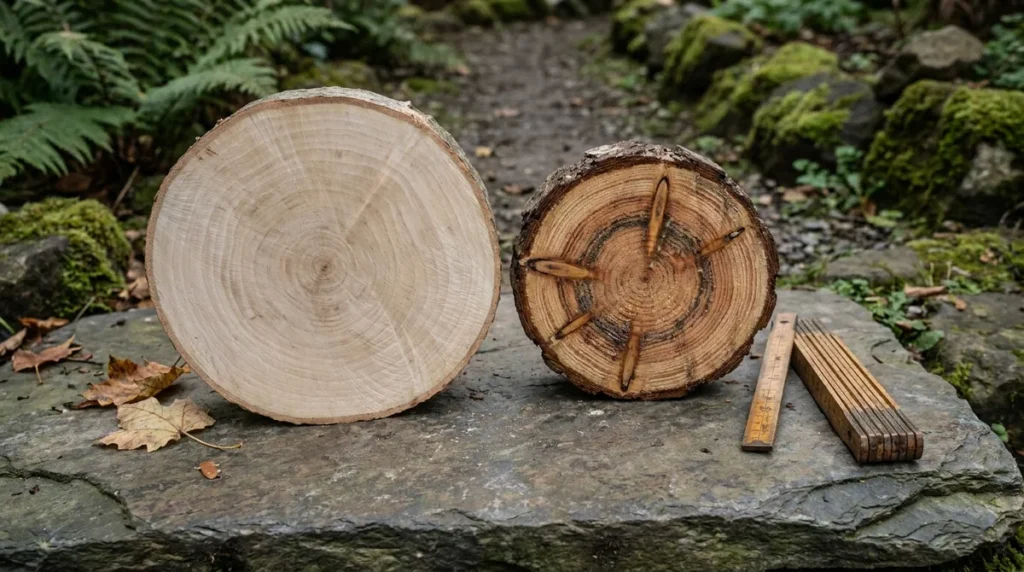
Yes, sycamore is a hardwood. But "hardwood" is a botanical class, not a hardness rating. American sycamore rates 770 lbf on the Janka scale — below longleaf pine, which is sold as a softwood. The label tells you what kind of tree it came from, nothing more.
That distinction is the whole reason this question keeps getting asked, and it is almost always answered badly. Before going further, one clarification this site exists to make: three unrelated trees are called sycamore, and they do not give the same answer. This page is about Platanus occidentalis, the American sycamore — the tree with the white flaking bark and the round seed balls. The British "sycamore" is Acer pseudoplatanus, which is a maple, and its timber is a different product in a different market (covered at the end). The sycamore fig, Ficus sycomorus, is an African fig; its wood matters historically — Egyptian coffins and boxes — but not in the modern lumber trade. If you are not sure which tree you are holding, start with the three trees that share the name sycamore.
The USDA Forest Products Laboratory makes the same point in its own species sheet: the name "sycamore" is used in England for a species in the hard maple group, while the Platanus growing there is called plane or planetree.
Hardwood means broadleaf, not hard
The split is taxonomic and has nothing to do with density:
- Hardwoods are angiosperms — flowering, broad-leaved trees, mostly deciduous in temperate climates. Oak, maple, ash, poplar, balsa, and sycamore are all hardwoods.
- Softwoods are gymnosperms — conifers, with needles or scales and naked seeds in cones. Pine, spruce, fir, cedar, yew.
Two examples break the intuition permanently. Balsa is a hardwood. Ochroma pyramidale is a broad-leaved flowering tree, so it is filed with the oaks, and it is the lightest and softest commercial timber on earth — roughly 67 lbf on the Janka scale. Model aircraft are built from a hardwood. In the other direction, European yew is a softwood: a conifer, around 1,520 lbf, harder than hard maple, and dense and springy enough that it was the timber of the English longbow.
Sycamore sits between those two poles and demonstrates the same thing in a less exotic way. It is a hardwood you can dent with a thumbnail if you press hard enough.
So how hard is sycamore, actually?
The Janka test — recorded as "side hardness" in USDA tables — measures the force needed to press a 0.444-inch steel ball halfway into the wood, across the grain. Higher number, more resistance to denting. All figures below are at 12% moisture content.
| Wood | Botanical class | Janka / side hardness |
|---|---|---|
| Balsa (Ochroma pyramidale) | Hardwood | 67 lbf |
| American sycamore (Platanus occidentalis) | Hardwood | 770 lbf |
| Longleaf pine (Pinus palustris) | Softwood | 870 lbf |
| Sycamore maple (Acer pseudoplatanus) | Hardwood | 1,050 lbf |
| White oak (Quercus alba) | Hardwood | 1,360 lbf |
| Hard maple (Acer saccharum) | Hardwood | 1,450 lbf |
| European yew (Taxus baccata) | Softwood | 1,520 lbf |
Figures for sycamore, longleaf pine, white oak and hard maple are from the USDA Forest Products Laboratory technical sheets (dry, 12% MC). Balsa, sycamore maple and yew are from The Wood Database, which is not a government source but is the standard reference for species FPL does not cover.
Read the table and the answer to the original question changes shape. Sycamore is about 43% below white oak and 100 lbf below a southern yellow pine. The FPL classifies it as "moderate" in weight, hardness, stiffness, shock resistance, bending strength and nail-holding — genuinely mid-range, and mid-range is not a criticism. It is why the wood ends up where it does.
Interlocked grain is the reason sycamore has a job at all
Sycamore's selling point has never been hardness. It is interlocked grain: successive growth layers spiral in alternating directions, so the fibers never line up into a clean splitting plane. The USDA describes the consequence precisely — sycamore "resists splitting by nails and screws."
That single property explains its traditional uses, all of which involve something being hit, driven, or repeatedly stressed:
- Butcher blocks. A surface that takes a cleaver thousands of times and does not open along a seam. The USDA's own monograph on the species lists butcher blocks as one of its preferred specialty uses.
- Handles for brushes and brooms, for the same reason — ferrules and rivets go in without splitting the wood.
- Boxes, crates and food containers. Sycamore is odorless, tasteless and stain-free, so it does not taint what it holds. Historically it was used for food and tobacco containers.
- Furniture drawer sides. Sycamore lumber is specifically prized for this: dimensionally reliable once dry, cheap, and it will not split where the drawer is nailed or dovetailed.
- Pallets and plywood. Lower grades go to pallets; the log peels and slices well, so a large share of production has always gone to veneer and furniture plywood.
The trade-off is at the machine. Interlocked grain tears out, so sycamore "requires the use of high-speed cutter heads to prevent chipping." It glues well, holds its shape after steam bending, and takes a very smooth surface — but it punishes dull tools.
Quartersawn sycamore is sold as lacewood
This is the part of the story most pages skip, and it is where the money in this timber sits.
Sycamore has unusually wide, conspicuous rays — the USDA compares them to the rays in quartersawn oak, though smaller, and notes that unlike oak they are darker than the surrounding wood. Saw the log radially (quartersawing) and you cut those rays lengthwise, exposing them as a dense speckle of dark flecks across a pale cream background. The figure is close to unmistakable.
The trade names for that cut are "lacewood" and "quartered sycamore" — both listed by the FPL as accepted common names for Platanus occidentalis. It is a cabinetmaking and decorative veneer material, and it is worth considerably more per board foot than plainsawn stock of the same tree. One caution when buying: "lacewood" is also used for an unrelated Australian timber (Cardwellia sublimis), so on a veneer label the name alone does not identify the species.
Quartersawing does a second job here, which is why the two arguments reinforce each other. See the next section.
Where sycamore lets you down
Two honest weaknesses, and neither is negotiable.
It is not durable outdoors. The FPL classes sycamore heartwood as nondurable against decay. In contact with soil or persistent moisture it goes quickly. This is interior lumber: furniture, cabinetry, drawer parts, veneer, flooring in dry rooms. Do not use it for decking, raised beds, fence posts, garden furniture or anything sitting on wet ground. If you are wondering what to do with a felled trunk that is not cabinet grade, that leads to a separate question — whether sycamore is any good as firewood.
It moves a lot as it dries. Green to oven-dry, sycamore shrinks about 8.4% tangentially and 5.0% radially, a ratio near 1.7. That gap between the two directions is what makes a board cup and twist, and the USDA states the outcome plainly: sycamore is "inclined to warp when plainsawn." Buy it properly kiln-dried, sticker and weight it while it acclimates, and give it time in the room before you build. Quartersawn boards move far less across their width — which is why the same cut that produces the lacewood figure also produces the most stable sycamore you can get. Figure and stability come out of the same saw pass.
The European sycamore is a different wood entirely
Acer pseudoplatanus — called sycamore across Britain and Ireland, sycamore maple in the United States — is a maple, and its timber behaves like one. At roughly 1,050 lbf it is meaningfully harder than American sycamore, close-textured, near-white, and it finishes to a very smooth surface.
Its premium market is musical: wavy or "fiddleback" figured stock has been used for the backs, ribs and necks of violins since the middle of the sixteenth century, and figured pieces command multiples of the price of plain ones. Beyond that it goes into fine furniture, interior joinery, flooring, decorative veneer and marquetry, where it is often dyed. Like its American namesake it is non-durable, so it stays indoors.
Same common name, two genera, two industries. That is the confusion this domain exists to sort out — see sycamore vs maple for the botanical version of the same problem.
The short answer, restated
Sycamore is a hardwood because it is a broad-leaved flowering tree, not because the wood is hard. It is moderately hard, unusually resistant to splitting, easy to glue, non-durable outdoors, prone to warping when plainsawn, and spectacular when quartersawn. Judge it on those properties, not on the word.
More on the timber, its grades and what it is worth in our guide to sycamore wood. To confirm which tree you are actually dealing with before you cut anything, work through sycamore tree identification or read the species profile of the American sycamore.
Recommended: