
Sycamore Maple (Acer pseudoplatanus): The British "Sycamore"
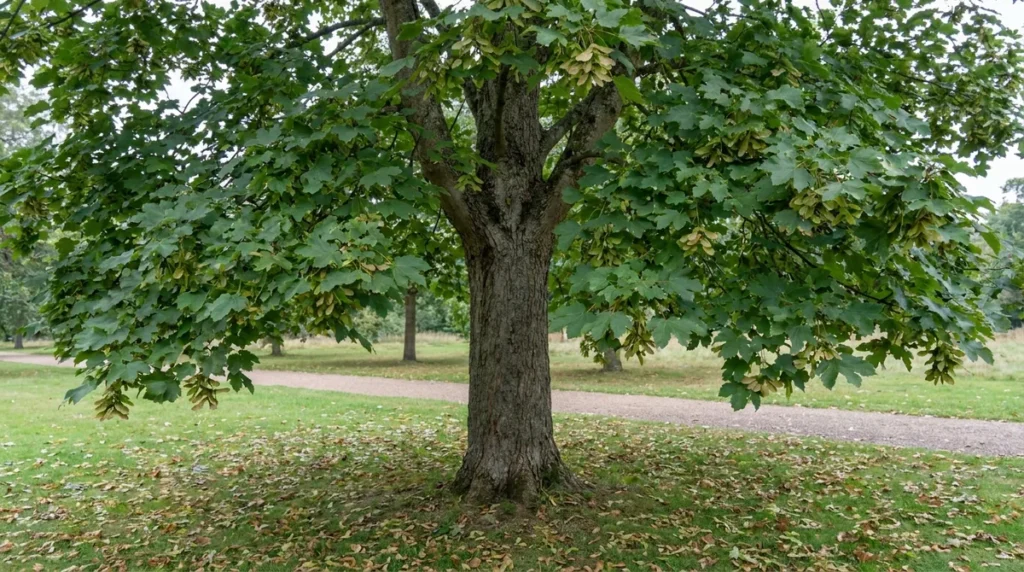
The sycamore maple (Acer pseudoplatanus) is a maple. It is not a plane tree, and it is not a fig. When a British or Irish book, nursery catalog, or news report says "sycamore," this is the tree it means — not the American sycamore (Platanus occidentalis), and not the sycamore fig of the Bible (Ficus sycomorus). One word, three unrelated trees, and this is the one almost nobody in North America pictures.
That mix-up costs more than it looks. Nearly everything written in English about "sycamore" helicopter seeds, about sycamore as a woodland weed, or about sycamore in old British landscapes is about this species. Read it while standing under an American sycamore in Ohio and almost none of it describes the tree in front of you.
- How do you tell a sycamore maple from an American sycamore?
- The bark tells you in winter
- Britain plants it and fights it at the same time
- Is sycamore maple invasive in the United States?
- Wind, salt, and limestone: what this tree is genuinely good at
- Sycamore seeds and horses: atypical myopathy
- Not the Bible's sycamore — but yes, the Sycamore Gap tree
- Why violin makers pay for this wood
- Should you plant one?
How do you tell a sycamore maple from an American sycamore?
One check settles it in two seconds, and it works on a bare twig in February: look at how the leaves and buds are arranged. Maples are opposite — leaves in matched pairs on either side of the twig. Platanus is alternate, staggered up the shoot. Nothing about lobe shape or leaf size is as reliable as that.
| Feature | Acer pseudoplatanus (sycamore maple) | Platanus occidentalis (American sycamore) |
|---|---|---|
| Leaf arrangement | Opposite | Alternate |
| Leaf | 5 well-marked palmate lobes, 7–16 cm across, heart-shaped base, stalk 5–15 cm and often reddish | 3–5 broad shallow lobes, 10–23 cm across, usually wider than long |
| Leaf stalk base | Normal | Swollen and hollow, wrapping the bud |
| Fruit | Paired samaras (helicopters), wings 2.5–5 cm, held at a closed angle of about 60° | Spherical seed balls of achenes, hanging on a stalk |
| Fall color | Yellow, orange, sometimes red | Dull yellow to brown — effectively none |
| Native range | Central Europe and western Asia | Eastern and central North America |
The fruit is the detail the internet gets backwards most often. The helicopter seeds belong to this tree, not to the American sycamore. Platanus never produces samaras at all; it makes hundreds of tiny achenes packed into a hard hanging ball that persists all winter and breaks up in spring. If you want the full set of field checks for all three trees, the sycamore tree identification guide works through them side by side, and sycamore vs. maple deals with the naming knot directly.
The bark tells you in winter
Young sycamore maple bark is smooth and gray. With age it flakes away in small irregular plates and reveals an orange to reddish-brown inner layer, so a mature trunk reads as gray stippled with warm patches. That is a different look from the American sycamore, whose upper trunk and limbs peel to a startling near-white, and from the London plane, which exfoliates to olive and khaki. Three trees, three completely different bark signatures — and bark is the one clue still available when the leaves are gone.
Britain plants it and fights it at the same time
Acer pseudoplatanus is not native to Britain or Ireland. The best-supported account has it arriving in the Tudor period, by around 1500; it was first recorded growing wild in Kent in 1632, planted widely through the 1700s, and reported as naturalizing from the mid-1800s. It has no old native name in any of the islands' languages, which is itself evidence it wasn't there before.
That timeline kills a whole genre of content. There is no ancient Celtic folklore of the sycamore — no druids, no ogham, no pre-Roman tree lore. A tree that arrived around 1500 cannot carry mythology from a thousand years earlier, whatever the search results tell you.
What it does have is a talent for spreading. It seeds prolifically, tolerates shade while young, and germinates in dense carpets, so it colonizes hedgerows, gardens, and semi-natural woodland without help. Great Britain's non-native species register lists it as an invasive non-native, and control in protected woodland is genuinely expensive: Forestry Commission Scotland costed sycamore removal on its protected woodland sites at roughly £300 per hectare, about double standard thinning. At the same time foresters value it for fast growth, good timber, and its willingness to grow where other broadleaves fail. Both things are true, which is why the British argument about this tree never ends.
Is sycamore maple invasive in the United States?
In parts of the country, yes — and in two states you are not allowed to sell or propagate it. It reached New York and New Jersey around 1870 and was planted through parks in New England and the Mid-Atlantic. It has since naturalized in New England, the New York City area, and the Pacific Northwest.
- Massachusetts: on the Prohibited Plant List — importation banned from July 1, 2006 and propagation banned from January 1, 2009.
- Connecticut: listed on the state invasive plant list, with the sale and movement restrictions that carries.
- Pacific Northwest: escaped and naturalizing, and flagged by regional invasive-plant groups, though not under the same statewide bans.
Practical reading: in the Northeast, don't plant it, and check your state and county list before you buy anything sold as "sycamore maple" or "planetree maple." Elsewhere, watch for seedlings. If you're choosing among the trees that carry this name, the sycamore tree types hub lays out which one actually suits which climate.
Wind, salt, and limestone: what this tree is genuinely good at
The honest case for sycamore maple is exposure. It shrugs off salt-laden coastal wind, upland exposure, and high-pH calcareous soils that stop most broadleaves, which is exactly why Scottish and Irish farms use it in coastal and hill shelterbelts and why it lines so many exposed field boundaries. It grows about 30–60 cm a year, quickly when young and then easing off, and it is hardy in USDA zones 4–7. Zone 7 is a real ceiling, not a formality: southern summer heat is what defeats it, not cold.
Sycamore seeds and horses: atypical myopathy
This is the part almost nobody cross-references with tree identification, and it is the reason to be able to name the tree in your paddock.
The seeds and seedlings of Acer pseudoplatanus contain hypoglycin A, which the horse's metabolism converts into a toxic metabolite (MCPA-CoA) that blocks fatty-acid oxidation. The result is atypical myopathy: rapid, severe breakdown of muscle, including the muscles the horse breathes with. Concentrations are highest in seeds in autumn and early winter and in seedlings in spring — the two windows when cases cluster.
Signs usually appear within 12–24 hours of ingestion: lethargy, weakness, trembling, stiffness, a fast heart rate, dark or reddish-brown urine, and going down. Affected horses often look colicky yet keep trying to eat, which delays the call. Reported case fatality in European series is high — commonly cited in the region of 70–90% — and survival improves substantially when horses reach a hospital early. Treat a suspected case as an emergency and call a vet immediately.
Two honest caveats. First, hypoglycin A content varies enormously between trees, between years, and between individual seeds from the same tree, so there is no reliable "safe number" of seeds; the figure of 50 seeds that circulates in the equestrian press has no firm institutional backing and shouldn't be used to reassure anyone. Second, the risk documented in the veterinary literature is to horses; toxicity to dogs is not established, and claiming it isn't supported.
What actually reduces risk: fence horses away from the drip line and from where seed blows, avoid grazing bare or overgrazed paddocks under these trees in autumn and spring, provide supplementary forage so horses aren't hunting for anything edible, and don't harrow affected paddocks — it spreads seed material around. Seeds, leaves, and seedlings can be tested for hypoglycin A through the Royal Veterinary College's diagnostic service. In North America the equivalent problem is box elder (Acer negundo), which carries the same toxin and causes seasonal pasture myopathy.
Not the Bible's sycamore — but yes, the Sycamore Gap tree
Two attributions that people reliably get the wrong way around.
The tree Zacchaeus climbed (Luke 19:4) was not this one. That was Ficus sycomorus, an African and Levantine fig with a low, spreading, climbable crown, growing in a climate where Acer pseudoplatanus cannot survive.
The tree at Sycamore Gap was exactly this one. The famous tree beside Hadrian's Wall in Northumberland was an Acer pseudoplatanus — a non-native maple, planted as a landscape feature in the late 19th century. It was felled overnight on September 27–28, 2023; Daniel Graham and Adam Carruthers were convicted on May 9, 2025 and sentenced on July 15, 2025 to four years and three months each. The full account is in the Sycamore Gap tree record.
Why violin makers pay for this wood
Sycamore maple timber is creamy white, fine and even in texture, hard, and takes a very smooth finish. Some trees develop a wavy grain that catches light in shimmering bands — the fiddleback figure — and that wood has been used for the backs, sides, and necks of violins since the mid-16th century. Figured stock commands a large premium over plain. Beyond instruments it goes into furniture, joinery, flooring, and decorative veneer, and it dyes well for marquetry. Its weakness is durability: it resists decay poorly and is an indoor timber, not a fence-post one. The sycamore wood guide compares it with the very different timber of the American species.
Should you plant one?
Only after two checks: whether it is legal and appropriate where you live, and whether horses graze anywhere near the site. If both clear, here is what you are committing to.
| Mature height | 12–18 m in cultivation; 30–35 m in woodland conditions |
|---|---|
| Crown spread | 8–15 m |
| Growth rate | 30–60 cm per year |
| Lifespan | 150–200 years, with recorded specimens near 400 |
| USDA zones | 4–7 |
| Distance from structures | 8–12 m minimum |
| Soil | Very adaptable; tolerates high-pH calcareous soil and coastal salt |
It is a smaller, less aggressive tree than the American sycamore, which needs far more room. Its real niche is shelter on an exposed or coastal site within its hardiness range. Its real cost is the seedlings: expect to pull them, every year, in every bed within a hundred yards.
Recommended: