
How Old Was the Sycamore Gap Tree? What the Rings Showed
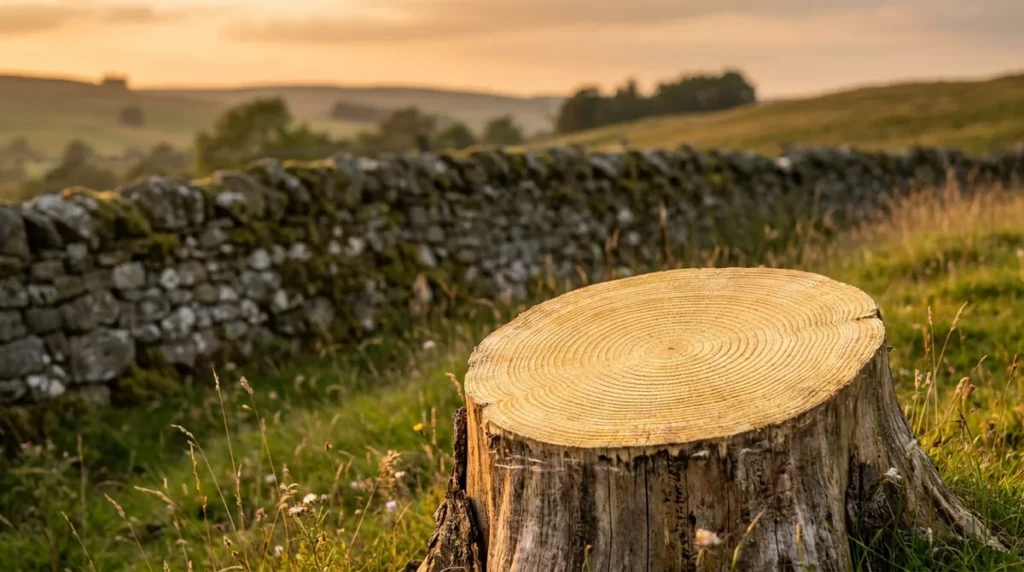
The Sycamore Gap tree was at least 100 to 120 years old when it was felled, and most probably somewhere around 130 to 150. That range is not hedging. It is exactly what the evidence supports, and anyone handing you a confident 200 or 300 is repeating a figure nobody ever measured.
The tree was an Acer pseudoplatanus, the sycamore maple — a maple, and not the American sycamore (Platanus occidentalis) that the same word means in the United States. The distinction matters for this question, because the two trees grow and age on completely different schedules.
- The rings finally set a floor — in 2025, not before
- Why the answer is a range and not a number
- Did John Clayton plant it? The dates do not quite work
- What the 1832 sketch proves, and what it doesn't
- Why people add a century to a tree like this
- It was not an old tree, and that is the hard part
- The short answer, claim by claim
The rings finally set a floor — in 2025, not before
On 4 September 2025, Historic England published the first research to scientifically analyse a sample of the tree itself. Until the tree came down, nobody could do this: a standing tree cannot be sliced through.
A slice was cut from the whole cross-section at the bottom end of the felled trunk, around a metre off the ground, and taken to Historic England's Fort Cumberland Laboratories in Portsmouth. The surface was levelled and sanded in stages, then the team counted rings along a series of transects across the face.
The result: an estimated 100 to 120 growth rings for the two main stems. One ring normally means one year, so the tree was at least 100 to 120 years old.
The word doing the work there is minimum. The cut was a metre up, and everything a tree records in its first years sits below that, in the base of the trunk. Historic England's own reading of its data is that the tree was first planted in the late 19th century — which puts the true age above the ring count, not at it.
Why the answer is a range and not a number
Sycamore is an awkward tree to date. Historic England's dendrochronologist, Cathy Tyers, noted two problems: sycamore ring boundaries are less obviously defined than those of oak or pine, and there is comparatively little reference data for historic sycamores to check a count against.
The slice showed it. Across most of the surface the rings were readable, but in places the boundaries faded, and there were growth anomalies — at one point a single boundary split into three separate rings before reforming into one.
There was one more finding, and it is the most useful thing in the report. A line of internal bark runs through the middle of the slice. The tree had once been several separate trunks that later fused into one; the two main stems grew together when they were roughly 30 to 35 years old. What looked like one massive trunk was a merger. Historic England has said the count may yet be refined using advanced imaging, so treat 100–120 as a floor that could move.
Did John Clayton plant it? The dates do not quite work
The standard story, and the one the National Trust gives, credits John Clayton (1792–1890) — Newcastle town clerk, lawyer and antiquarian — with planting the tree as a landscape feature in the late 1800s. Clayton is a real and important figure here: he bought land along Hadrian's Wall specifically to protect it, and by his death owned five Roman forts and roughly 20 miles of it. On that account the tree would have been about 150 years old.
The archaeology complicates it. Jim Crow, Emeritus Professor of Roman and Byzantine Archaeology at Edinburgh, who directed the excavations along this stretch of Wall between 1982 and 1989, points to two dates that sit badly together:
- The Northumbrian historian John Hodgson (1779–1845) sketched a tree standing in the gap in his unpublished journals on 18 October 1832 — the earliest known representation of it. The sketch shows the tree inside a stone enclosure, built to keep grazing cattle and sheep off it. That enclosure then appears on the first six-inch Ordnance Survey map of 1860.
- Clayton did not buy Steel Rigg farm — the holding that includes Castle Nick and Sycamore Gap — until 1834.
A tree was already growing there, and already worth fencing, two years before Clayton owned the ground. He may have replanted, replaced or simply looked after what was there, but he cannot have planted the tree Hodgson drew.
What the 1832 sketch proves, and what it doesn't
It fixes a latest-possible date for a sycamore at that spot, nothing more. Crow reads Hodgson's drawing as a fairly immature tree and argues it was planted around the enclosure of Henshaw Township in 1787, as a deliberate landmark between fields and visible from the new Newcastle-to-Carlisle turnpike — the Military Road, financed in the 1750s and running about 530 m to the south.
But 1787 to 2023 is 236 years, and the rings say 100–120 at a metre up. There are two ways to square that, and neither has been proved:
- Different tree. The sycamore Hodgson sketched died or was replaced, and a successor was planted in the same protected spot later in the century.
- Same stool, younger stems. Sycamore maple regrows vigorously from a cut or browsed base — exactly what the surviving stump is doing now. The internal bark line is the signature of that kind of regrowth, so the stems that were counted could be later shoots on a much older root system.
The defensible statement is this: the site has held a sycamore since at least 1832, and the individual stems that fell were considerably younger than that.
One myth worth killing while we are here. This was never a survivor of ancient woodland. A pollen core from the west end of Crag Lough, 120 m north-west of the gap, shows a landscape cleared of trees since the late Neolithic — roughly 4,000 years. The tree was planted furniture in an open, farmed landscape.
Why people add a century to a tree like this
This is where botany explains the guesswork, and it is the part the news coverage skips.
Sycamore maple is fast. It puts on 30–60 cm a year, and the Sycamore Gap tree stood roughly 15 m (49 ft). At that rate a sycamore reaches 15 m in something like 30 to 50 years. Height told you almost nothing about its age.
A lone tree fattens differently. Solitary, open-grown trees develop a larger stem diameter, a lower overall height and a wider crown than forest trees of the same age, and their radial growth is measurably faster — they never compete with neighbours for light. A thick trunk on an isolated tree in a field is a growth-form signature, not an age signature.
And this trunk was two trunks. Fused stems mean the girth people were reading contained the wood of more than one stem. The most impressive-looking evidence for great age was in fact evidence of the opposite.
The visual cues that make people say "300 years" — heavy trunk, spreading crown, standing alone — are precisely what a fast, open-grown, multi-stemmed sycamore maple looks like at 120. For the species behind that behaviour, see our guide to the sycamore maple, the British "sycamore".
It was not an old tree, and that is the hard part
Sycamore maple typically lives 150 to 200 years, with exceptional specimens reaching 400, and the species is considered mature from around 50.
So at 100–150 years the Sycamore Gap tree was fully grown and long past maturity, but nowhere near the end of its life. On the species' own timetable it had decades left, and quite possibly another century. It was a healthy middle-aged tree that was cut down.
The short answer, claim by claim
| Figure you will see | Status |
| "300 years" / "centuries old" | Unsupported. Contradicted by the ring count and by the documented history of the site. |
| "Nearly 200 years" | Not supported by the rings. Possible only if you date the site rather than the stems that fell. |
| "About 150 years" (planted by Clayton, late 1800s) | Compatible with Historic England's late-19th-century planting date. A reasonable upper end. |
| "At least 100–120 years" | The firm minimum. Measured on the wood itself, Historic England, September 2025. |
| Best defensible answer | Roughly 130–150 years, with a hard floor of 100–120. |
There is a bleak irony in all of this: the question could only be answered because the tree was destroyed on the night of 27–28 September 2023. The slice that produced the count is now stored at Fort Cumberland and is expected to enter Historic England's National Wood Collection. For the felling and the prosecution, see who cut down the Sycamore Gap tree; for the stump and what to expect if you walk out to it, see the Sycamore Gap tree now. Everything else is gathered on our Sycamore Gap tree page.
Recommended: