
London Plane Tree: The Hybrid That Cities Run On
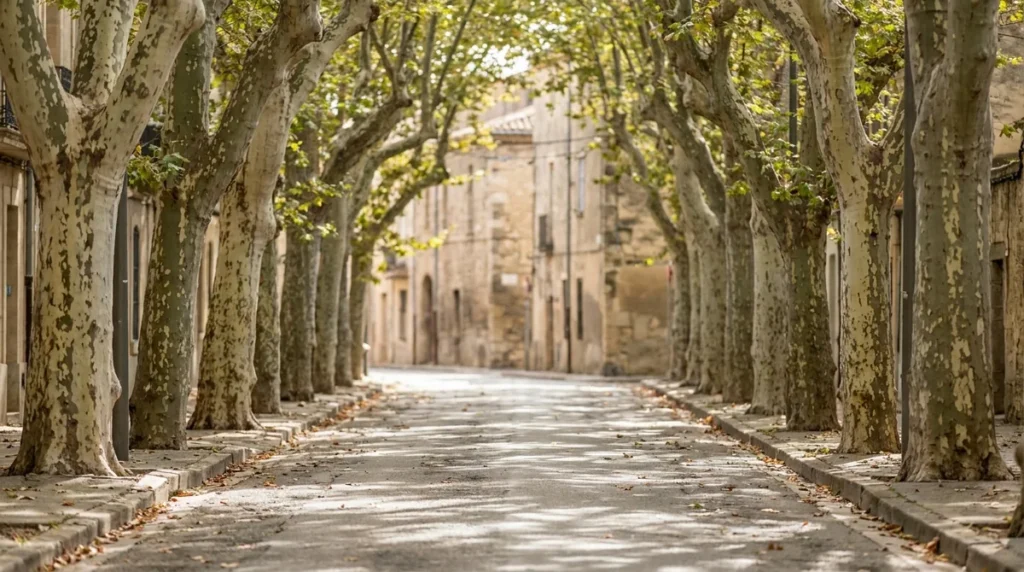
The London plane (Platanus × acerifolia) is not a wild species. It is a hybrid between the American sycamore (Platanus occidentalis) and the Oriental plane (Platanus orientalis), it turned up in a garden in the 17th century, and it is now the most widely planted street tree in the Western world.
It is also a large part of why the word "sycamore" is such a mess. In North America, "sycamore" means Platanus occidentalis, and the London plane is that tree's hybrid offspring. In Britain, "sycamore" means Acer pseudoplatanus — a maple, no relation to either. And the sycamore of Luke 19:4 is Ficus sycomorus, an African fig. This page is about the hybrid plane only. If you cannot tell which of the two Platanus is in front of you, our side-by-side on how to tell a sycamore from a London plane settles it in seconds.
- Nobody actually knows where the first one came from
- Why cities kept planting it for three hundred years
- What the peeling bark does — and what it doesn't
- The knuckled trees on European streets are pollarded, not deformed
- How big does it get, and how fast?
- 'Bloodgood', 'Liberty' and 'Columbia' are London planes, not American sycamores
- The three drawbacks that don't make the brochure
- So do you want one?
Nobody actually knows where the first one came from
The argument is embedded in the tree's own name. Botanists use two: Platanus × acerifolia, meaning maple-leaved plane, and Platanus × hispanica, meaning Spanish plane. The second name exists because one line of evidence points to the hybrid arising in Spain, where both parent species were being grown together.
The strongest documentary trail, though, runs through Oxford. A manuscript by Jacob Bobart the Younger, Keeper of the Oxford Physic Garden — undated, but generally placed in the 1660s — lists three planes growing there: the eastern, the western, and one "halfway between the eastern and the western." He catalogued it as Platanus inter orientalem et occidentalem media, and two herbarium specimens from the later 17th century survive to back the record up. A third version, more popular in Britain, credits John Tradescant the Younger's nursery at Vauxhall in London. Some accounts push the original cross back as far as the 1640s.
What is settled is the parentage and the century. What is not settled is the garden. Anyone who tells you flatly it was "created in Oxford in 1670" is tidying up a record that is genuinely unresolved.
Why cities kept planting it for three hundred years
Not for its looks. The London plane got its job because it tolerates the specific combination of abuse that kills almost everything else planted in a sidewalk cutout: compacted soil, air pollution, de-icing salt, drought, reflected heat off pavement, and repeated hard pruning. Extension services list it as tolerant of compaction, drought and salt at once — an unusual set in one tree.
Its reputation was made in coal-era London, where planes went on growing in streets whose air was visibly black and where most other species simply died. The scale of what followed is easiest to see in New York: the London plane is the city's single most common street tree, with more than 80,000 of them across the five boroughs — roughly 13% of all street trees.
That concentration is a liability as much as an achievement: a street planted with one clone-heavy hybrid is a street that one pathogen can empty. If you want the wider picture of which plane or sycamore goes where, start from our guide to the sycamore and plane tree types.
What the peeling bark does — and what it doesn't
The camouflage-patterned trunk comes from two things at once. The first is growth: the outer bark of a plane is rigid and cannot stretch, so as the trunk expands it fractures and falls away in irregular plates, exposing the smoother, paler layer beneath. That is why the peeling is heaviest on vigorous young wood and high in the crown.
The second is housekeeping. Shedding those plates takes with them the soot, dust and particulate matter that had settled on the surface and would otherwise sit over the bark's lenticels — the pores it breathes through. In a coal-smoke city that mattered.
Here is the part the internet usually gets wrong. The tree does not absorb urban pollution into its bark and lock it away. Particles adhere to the bark surface and get caught in the hairs on the leaves; shedding removes them from the tree and drops them on the ground. It is self-cleaning, not filtration — still a good story, with the advantage of being true.
The color left behind is also the fastest field mark between the two planes, and the American sycamore profile covers that species on its own terms.
The knuckled trees on European streets are pollarded, not deformed
Plane trees in Paris, Madrid, London and Rome carry swollen, club-headed stubs topped with whippy shoots. That is pollarding: the upper branches are cut back to the same points every cycle, and over decades those repeated cut points swell into knuckles.
The reason is arithmetic. An unpollarded London plane reaches 21-30 m (70-100 ft) with a canopy of 18-23 m (60-75 ft). No boulevard, balcony or overhead wire survives that. Pollarding keeps the tree at a chosen ceiling permanently.
The tree tolerates it because of the trait that makes it an urban survivor: it resprouts readily from cut wood. But it is a commitment. Once a plane has been pollarded the cycle has to be maintained — knuckles left to push out long, heavy limbs become a failure risk. Our guide to pollarding and coppicing sycamore and plane trees covers timing and technique.
How big does it get, and how fast?
Slower than its American parent, which is the one figure almost nobody publishes.
| London plane (P. × acerifolia) | American sycamore (P. occidentalis) | |
|---|---|---|
| Growth rate | 30-60 cm/year (12-24 in) | 60-90 cm/year (2-3 ft) |
| Mature height | 21-30 m (70-100 ft) | 23-35 m (75-115 ft) |
| Canopy spread | 18-23 m (60-75 ft) | 20-30 m (65-100 ft) |
| Lifespan | 200-300 years | 200-300 years |
| USDA zones | 5-9 | 4-9 |
| Minimum distance from foundations | 12 m (40 ft) | 12 m (40 ft); 18 m if clay or a basement |
The London planes of central London routinely pass 200 years and are still going. 'Bloodgood', the most common named selection, tops out nearer 18 m, which is the only version of this tree that belongs anywhere near a normal property line.
'Bloodgood', 'Liberty' and 'Columbia' are London planes, not American sycamores
This is the most repeated factual error in the whole niche, and it is worth stating plainly: those three cultivars belong to Platanus × acerifolia. You will find them attributed to American sycamore in nursery listings, plant databases and a great deal of copied web content.
'Columbia' and 'Liberty' have a documented origin. Frank Santamour at the US National Arboretum in Washington DC made controlled crosses between native P. occidentalis and P. orientalis of Turkish provenance in 1968-70, and the two selections were released in August 1984. Both were chosen for resistance to anthracnose and powdery mildew. 'Bloodgood' is the older selection with the long-standing anthracnose reputation. The Morton Arboretum's Exclamation! ('Morton Circle') came out of George Ware's crosses and was selected for anthracnose and frost-crack resistance.
The critical word in all of that is resistance, not immunity. 'Columbia' has performed noticeably worse against anthracnose on the American West Coast than in the East, which tells you that this resistance is climate-dependent rather than absolute. A cold, wet spring will still put anthracnose on a resistant plane. That is the disease that disfigures P. occidentalis most consistently, and the reason the hybrid displaced it as a street tree at all — see the common sycamore and plane tree diseases for what to look for.
One thing you cannot buy your way out of: Platanus is monoecious. Male and female flowers sit on the same tree. There is no male-only clone that skips the seed balls, and any nursery or article offering you a "female-free" plane on that basis is selling something that does not exist.
The three drawbacks that don't make the brochure
It sheds irritants, and they are not pollen. Plane leaves release fine hairs called trichomes, and the seed balls release fibers as they break up in spring. Both act as mechanical irritants to eyes, nose, throat and airways — a foreign-body sensation, scratchiness and cough. Because it is irritation rather than an immune reaction, antihistamines do not address it, which is why people misdiagnose it. On top of that, plane pollen is a documented allergen in its own right. Our page on sycamore and plane tree allergies separates the two mechanisms.
It is far too big for a normal plot. A canopy of 18-23 m is not a garden tree; it is a park tree that happens to be planted in gardens. If your site is a suburban lot, the honest answer is a different species — the small-garden alternatives are worth reading before you buy.
It lifts pavement and finds pipes. Plane roots do raise sidewalks and do enter sewer lines. But the mechanism matters: they do not push sound foundations over. The real damage is drying out clay soil, which causes differential settlement, and entering drains that already had a crack or a loose joint. Roots are also markedly less invasive given enough soil volume: street-tree guidance asks for at least 12 feet of soil between sidewalk and curb. Keep it 12 m (40 ft) from foundations and 15 m (50 ft) from sewer and drainage runs, and read managing plane and sycamore roots near structures before you dig.
So do you want one?
Plant a London plane if you have real space, a site at least 12 m from any building, and conditions that would kill a more particular tree: compacted urban soil, salted pavement, poor air, a long dry summer. It will give you a 200-year canopy in a place where most species manage twenty.
Skip it if your plot is standard suburban, if there are overhead lines, if anyone in the household has reactive airways, or if you are not prepared to sweep leaves, bark plates and seed balls for the rest of your life. And if it was the mottled trunk that drew you rather than the size, every member of this genus gives you that — including several that will not outgrow your property.
Recommended: