
Sycamore Seeds and Balls: Which Tree Dropped Them?
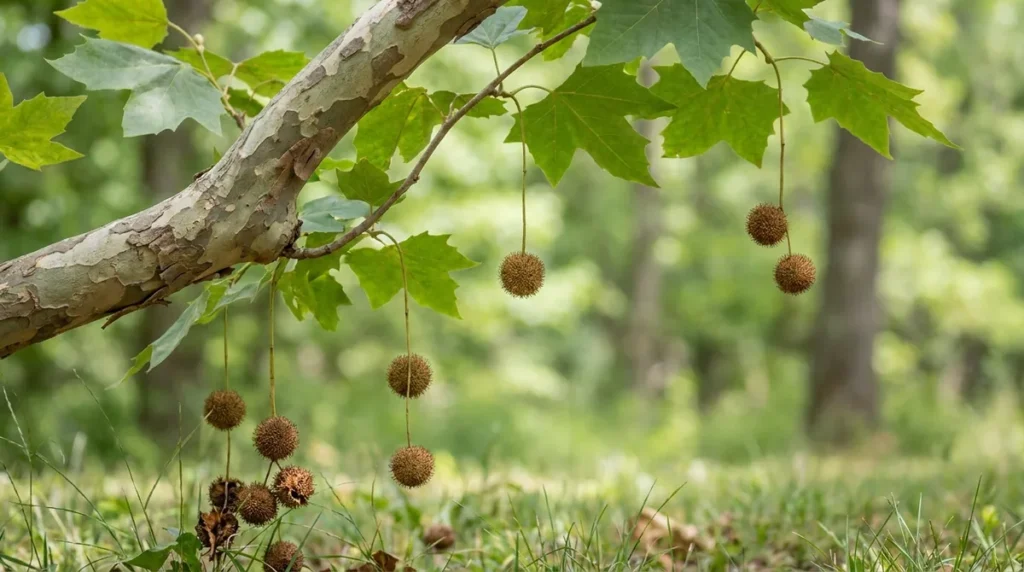
Round, bristly balls hanging on a long stalk are the fruit of a Platanus — American sycamore or London plane. Spinning “helicopter” seeds are not sycamore fruit at all. They are samaras, and they belong to Acer pseudoplatanus, the maple that Britain calls sycamore.
That distinction is the most-broken fact in this subject: page after page describes the American sycamore dropping helicopter seeds, which it has never done. “Sycamore” is the common name of three unrelated trees, and each one produces a completely different fruit. This page sorts out which is which, when it falls, and what to do about the mess.
- Which tree dropped what you're holding?
- A sycamore ball is not a seed, and it is not a samara
- Count the balls on the stalk — the field test almost nobody uses
- If your sycamore seeds spin, you have a maple
- And if the fruit grows out of the trunk, it's a fig
- When do sycamore balls actually fall?
- There is no fruitless sycamore to buy instead
- The hairs are the real nuisance, not the balls
- Are sycamore seeds poisonous to dogs?
- What the balls are good for
- Can you grow a tree from them?
Which tree dropped what you're holding?
| What you found | The tree | What it actually is |
|---|---|---|
| A hard, bristly ball about an inch across, hanging alone on a long stalk | American sycamore (Platanus occidentalis) | A head of achenes — a “buttonball” |
| Two balls, sometimes three, on the same stalk | London plane (Platanus × acerifolia) | The same fruit type, differently arranged |
| A string of several smaller balls down one stalk | California sycamore (Platanus racemosa) | The same fruit type again |
| Paired winged seeds that spin as they fall | Sycamore maple (Acer pseudoplatanus) | Samaras — the helicopters |
| Figs growing straight out of the trunk and heavy branches | Sycamore fig (Ficus sycomorus) | Syconia, borne by cauliflory |
If your tree is a Platanus, everything in the next three sections applies. If it is the British sycamore, skip ahead — you have a maple, and our side-by-side comparison of sycamore and maple explains why the name collides.
A sycamore ball is not a seed, and it is not a samara
What hangs off an American sycamore is not one fruit but hundreds of them packed into a sphere. Each unit is an achene: a dry, one-seeded fruit roughly 8–9 mm long with a ring of stiff bristles at its base. They are pressed around a fibrous core, and that core is what makes the ball feel hard rather than fluffy.
The ball itself runs about 2.5–3.5 cm (1 to 1.4 inches) across on a slender stalk several inches long. That fruit is where two of the tree's older American names come from: buttonball and buttonwood. Colonists named the tree “sycamore” only because its leaves reminded them of the sycamore they had left behind in Britain — which, as it happens, is the maple. The naming problem is that old.
Nothing about this fruit spins. When the head breaks apart, the bristled achenes drift on the wind and float on water, which is how a floodplain tree colonizes a riverbank. For the full profile, see our page on the American sycamore.
Count the balls on the stalk — the field test almost nobody uses
Bark tells you a tree is a plane; it does not reliably tell you which one. The fruit does, and the test takes one glance.
| Species | Fruit heads per stalk |
|---|---|
| Platanus occidentalis — American sycamore | Usually one; occasionally two |
| Platanus × acerifolia — London plane | Two, sometimes three |
| Platanus racemosa — California sycamore | Two to seven, hanging in a chain |
Two caveats. Check several stalks, not one: a London plane will occasionally hang a solitary ball, and an American sycamore will occasionally hang a pair. And the fruit sits high in the crown, so binoculars beat squinting. Pair the count with bark color — the American sycamore goes chalk white and smooth in the upper crown, the London plane stays more olive-khaki — and you have a confident call. We walk through the rest of the differences in sycamore tree vs London plane, and cover the wider genus in our guide to sycamore tree types.
If your sycamore seeds spin, you have a maple
Search “sycamore seeds helicopter” from the UK or Ireland and you are almost certainly looking at Acer pseudoplatanus. It is a true maple, and its fruit is a samara: two winged seeds joined at the base, set at a tight angle of roughly 60 degrees, each wing an inch or two long. Release the pair and it autorotates. That is the helicopter everyone remembers from childhood, and no Platanus produces one.
Sycamore maple samaras ripen in late summer and come down through autumn. One more thing worth knowing if you are in Britain: this tree is not native there. It arrived around 1500, and it seeds itself into hedgerows, gardens and woodland with real force — which is why so many British gardeners meet these seeds as a weeding problem rather than a curiosity.
And if the fruit grows out of the trunk, it's a fig
The third sycamore, Ficus sycomorus, produces neither balls nor helicopters. It bears figs, and it bears them straight from the trunk and the older branches in clusters, on short leafless shoots — a habit called cauliflory. The figs run roughly 2–5 cm across. This is an African and Middle Eastern tree that dies in frost, so unless you are in a genuinely frost-free climate, you are not looking at one. It is, however, the tree in the Zacchaeus passage and the other biblical references to the sycamore.
When do sycamore balls actually fall?
Later than most people expect, and that timing explains a lot of frustrated searching.
The heads ripen to brown in autumn and then simply hang there. They persist on the bare tree all winter — that is one of the easiest winter identification cues you get — and they break up or drop the following spring. So the debris arrives in March and April, not in October with the leaves. If you have spent an autumn raking sycamore leaves and congratulated yourself on being done, the fruit is still overhead waiting for you.
When a head disintegrates it does not land as a ball. It lands as a scatter of bristled achenes plus a drifting cloud of loose hairs, which is why sweeping it up feels less like clearing nuts and more like clearing lint.
There is no fruitless sycamore to buy instead
Platanus is monoecious: male and female flowers sit on the same tree. There are no male trees and no female trees, so any advice to plant a “female cultivar” to avoid pollen, or a male one to avoid fruit, is describing a plant that does not exist. Named cultivars such as 'Bloodgood', 'Liberty' and 'Columbia' are London plane selections, and they were chosen for partial resistance to anthracnose, not for going fruitless.
What you can control is where the tree stands. Keep an American sycamore at least 12 m (40 feet) from house foundations and about 15 m (50 feet) from a pool — and in that last case the reason is almost entirely the litter, not the roots. Mow-and-mulch beats raking for the achenes on lawn. If the tree is already in the wrong place, start by identifying which sycamore you have.
The hairs are the real nuisance, not the balls
Handle a disintegrating fruit head and you release fine hairs called trichomes. Air sampling around London planes in Sydney found these trichomes airborne and small enough to be inhaled, and researchers there described them as a respiratory irritant. Notably, the same work found the trichomes did not bind IgE from any of the study subjects, which points to mechanical irritation rather than a true allergy.
The practical upshot: wear gloves and a dust mask if you are shredding, blowing or bagging sycamore fruit litter in spring, and work on a still day. Our page on sycamore tree allergies separates this irritation from the pollen question, which is a different problem in a different season.
Are sycamore seeds poisonous to dogs?
Here the two trees give opposite answers, and conflating them is how bad advice spreads.
If it is a Platanus: no part of the tree appears on the ASPCA's list of plants toxic to dogs. The risk is mechanical, not chemical. The balls are fibrous and indigestible, so a dog that chews them can end up with vomiting or diarrhea, and a dog that swallows them whole or in quantity has a genuine choking and obstruction risk. Treat them as you would any hard inedible object your dog has decided to eat.
If it is Acer pseudoplatanus: the seeds contain hypoglycin A, and that is a serious, well-documented toxin. It causes equine atypical myopathy, a frequently fatal muscle disease in horses, with the toxin concentrated in the seeds in autumn and early winter and in the seedlings in spring. Cases have also been reported in other animals. Toxicity in dogs specifically is not established in the veterinary literature, so we are not going to claim it — but there is no upside to letting a dog eat them, and if you keep horses anywhere near a sycamore maple, that is a hazard worth raising with your vet.
What the balls are good for
Dried sycamore fruit heads hold their shape well and take paint, glitter and wire, which is why they turn up in wreaths, garlands and ornaments. The trick is timing: collect them in late autumn or early winter while the head is still firm and tightly packed, because once spring loosens it the ball crumbles the moment you handle it. Dry them somewhere airy for a couple of weeks first, and sort them outdoors for the same trichome reason as above.
Can you grow a tree from them?
You can, and it is easier than most seed-raised trees, because a single head carries hundreds of viable achenes and you only need one to take. Break up a ripe head, separate the achenes from the hairs, cold-stratify them and sow shallow — the full process is in our guide to harvesting and germinating sycamore seed.
Just be sure which tree you collected from first. An American sycamore in a suburban yard is a very different commitment from a sycamore maple seedling — and neither of them is the fig.
Recommended: