
Sycamore Gap Tree Now: What's There in July 2026
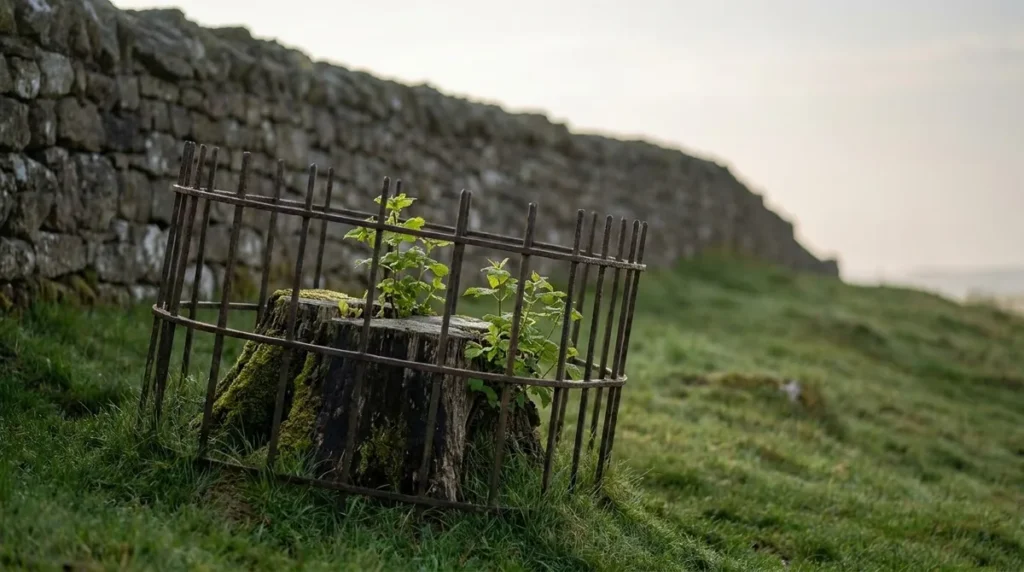
As of July 2026 the stump at Sycamore Gap is alive and sprouting for a third year running, protected inside a fenced cage. The trunk itself is indoors, two miles away, at The Sill. Nothing has been replanted in the gap.
That is the short answer, and everything below is the detail behind it. The tree that stood there was a sycamore maple (Acer pseudoplatanus) — a maple, not the American sycamore (Platanus occidentalis) and not the fig of the Bible. If you are wondering why one dip in a Roman wall generates three different trees, that is the confusion this site exists to sort out; start with the three unrelated trees called sycamore. The species matters here for a very practical reason: the maple's biology is the only reason there is any living story left to tell. The tree was felled overnight on 27–28 September 2023.
This page describes the site as of July 2026. It is the most perishable page on this website and it is dated deliberately.
- What is physically at the site right now?
- Why can a stump that old sprout at all?
- How many shoots, and what will be done with them?
- The 49 ‘Trees of Hope’ — and why they are not the tree
- Where did the trunk go?
- What is coming next: The People's Tree
- So has the future of the site actually been decided?
- If you are planning to visit
What is physically at the site right now?
Four things, and one absence:
- The stump, in its original position, alive, with new shoots growing from its base.
- A protective enclosure around it — a fence with netting stretched over the top to form a cage. The National Trust and Northumberland National Park Authority installed it in October 2025.
- The wall and the path, unchanged and open. Hadrian's Wall runs through the gap as it always did.
- Signage and stewardship asking visitors to keep off the stump and the soil around it.
- No replacement tree. Nothing has been planted in the gap, and the current intention is not to plant one.
The netting was not decorative. Visitors had been leaving stones, coins and written tributes on the stump and the soil around it, and both organisations concluded that the tributes themselves were becoming the threat. Andrew Poad, the National Trust's General Manager at Hadrian's Wall, put it bluntly when the cage went up: the regrowth is “extremely fragile”, and every step on the soil or contact with the stump risks damaging the tree's chance of recovery.
Why can a stump that old sprout at all?
This is the part the news coverage skips, and it is the genuinely interesting bit.
Acer pseudoplatanus resprouts from the cut stool with real vigour. That is a documented silvicultural property of the species, not a miracle: Forest Research lists sycamore as a principal British species precisely because its behaviour is well understood, and the coppice literature describes its stump shoots as few in number but strongly grown while young. Cut a young sycamore at the base and you do not get a corpse, you get a cluster of fast vertical shoots. That is exactly what coppicing and pollarding a sycamore is designed to exploit.
Here is the caveat that makes the Sycamore Gap regrowth genuinely newsworthy rather than routine. That vigour is an attribute of young trees. Silvicultural reviews of sycamore coppice report that the resprouting capacity falls away sharply after about 40–50 years, with roughly 80–100 years given as the practical upper limit at which a sycamore stool can still be expected to shoot. The Sycamore Gap tree was older than that. Estimates of its age vary widely and the sources genuinely disagree — the National Trust describes it as a landmark for nearly two centuries, while other accounts put it at 100–120 years — but every version places it at or beyond the age where a forester would stop counting on regrowth.
So the shoots were not guaranteed. They are a stump performing above the expectation the textbooks set for it.
The same literature carries the warning that goes with the good news: sycamore stools can rot, and the shoots they throw are not always long-lived. A stump this size, cut this brutally and this late in life, has a large exposed wound and a root system that suddenly has no canopy to feed it. Nobody involved is treating the regrowth as safe. That is why the enclosure exists and why the ask is patience rather than celebration.
How many shoots, and what will be done with them?
The last figure the National Trust published for the stump was 25 shoots emerging from the base. Its May 2026 update did not repeat a count — it confirmed that shoots were regrowing for the third consecutive year and left it there. Treat 25 as the last published number rather than a live census, and expect the figure to move: the shoots dropped their leaves and went dormant over the winter of 2025–26, then came back in spring.
The management plan is deliberately non-committal, and that is a reasonable position rather than an evasion. The stated approach is to leave every shoot alone for a few years and watch how they develop. Only later will anyone decide whether to manage the result as a coppiced stool — a multi-stemmed cluster, which is what the stump is naturally producing — or to reduce it to a single stem and let one shoot become a tree. Alongside that, the work is to protect the root zone and avoid soil compaction, which is the same thing as keeping people off the ground around it.
By autumn 2025 enough shoots had reached the original fence that a larger enclosure was expected to be needed before the following spring. That is a good problem to have.
The 49 ‘Trees of Hope’ — and why they are not the tree
The National Trust's Trees of Hope programme distributed 49 saplings, one for each foot of the tree's height when it was felled — about 49 feet, or 15 metres, which is an entirely ordinary size for a mature sycamore maple in an exposed upland spot.
The saplings were grown from seed rescued from the felled tree and raised at the Trust's Plant Conservation Centre until they stood roughly four to six feet tall. Nearly 500 applications came in for the 49 places. The first were planted on Saturday 22 November 2025, during National Tree Week, at sites including The Tree Sanctuary in Coventry, the Minnie Pit mining disaster memorial in Staffordshire and Greenham Common in Berkshire; later that week saplings went to the Rob Burrow Centre for Motor Neurone Disease in Leeds and Hexham General Hospital, among others. All were planted in publicly accessible places. The first sapling to germinate successfully was gifted to the King for planting in Windsor Great Park.
Now the botanical footnote nobody prints. Those 49 saplings are the tree's offspring, not copies of it. Sycamore maple is an outcrossing species — its flowering is heterodichogamous, with male and female phases separated in time specifically to avoid self-pollination, and it is pollinated by both wind and insects. Seed from that tree carries pollen from other sycamores in the wider landscape. Genetically, the saplings are half-siblings of each other and children of the Sycamore Gap tree, and they will not grow into replicas of it.
The only genetically identical continuation of the original tree is the thing inside the cage on the Northumberland ridge. That is what makes the stump the real story.
Where did the trunk go?
Indoors, and you can touch it. The largest surviving section of the trunk — a piece a little over six feet (2 m) long — has been on permanent public display since 11 July 2025 at The Sill: National Landscape Discovery Centre, about two miles from the gap.
It stands upright, as the tree did. The artist Charlie Whinney, working with the Creative Communities CIC collective and commissioned by Northumberland National Park Authority, set it inside a surround of steam-bent wood with three benches, carrying words drawn from a public consultation — phrases like “old friend” and “from this land”. The installation is free, step-free and explicitly designed to be touched, which was the single most common request from the public. If you want to be near the actual wood of the tree, this is where you go, not the ridge.
What is coming next: The People's Tree
On 23 May 2026 the National Trust announced the winner of the commission for the rest of the salvaged timber. The People's Tree, by the North Shields arts charity Helix Arts with London-based George King Architects, was chosen from six shortlisted teams by a combination of national public vote and an expert panel.
It is not a statue. The plan is a UK-wide participatory programme in which people record their own reflections on trees and nature, combined with a soundtrack generated by scanning the tree's growth rings and turning that data into audio. Sections of the seasoned wood will be used in community artworks, and the project ends in a sound sculpture containing a time capsule — wood from the tree plus the archive of recordings — sited somewhere accessible along Hadrian's Wall. Public participation was due to begin in summer 2026, with the finished work expected by September 2027.
So has the future of the site actually been decided?
| Question | Status as of July 2026 |
|---|---|
| Will a new tree be planted in the gap? | Settled, in practice: no. The approach is natural regrowth from the existing stump, not replanting |
| Is the stump alive? | Yes. Shoots confirmed for a third consecutive year in May 2026 |
| Coppiced stool or single stem? | Open. Explicitly deferred for several years while the shoots are observed |
| Will one of the shoots become a full tree? | Open, and not assured. Depends on the stool not rotting and the shoots surviving |
| Where is the wood? | Settled. Largest section on permanent display at The Sill; remaining timber allocated to The People's Tree |
| Legal case | Closed. Daniel Graham and Adam Carruthers convicted 9 May 2025, sentenced 15 July 2025 to four years and three months |
The one thing that is genuinely unknowable is the timescale. A stool that resprouts still has to build a trunk, and a sycamore maple in an exposed, wind-scoured gap on a limestone ridge grows more slowly than one in a sheltered valley. Nobody involved is putting a date on when there will be a tree in the gap again, and anyone who gives you a precise year is guessing.
If you are planning to visit
Go, and stay on the path. The site is open and the walk is the same one it always was. The two requests from the National Trust and Northumberland National Park Authority are simple: do not climb on the enclosure, and do not leave physical tributes on the stump or the soil around it. Photographs and stories are welcome; stones and coins are not, because the compaction and the covering are what put the shoots at risk.
If you want to see the tree rather than the ground it grew in, drive the two miles to The Sill.
For the tree's full history, the height, the age dispute and the film that made it famous, see the Sycamore Gap tree hub. For the felling itself, the investigation and the sentences, see who cut down the Sycamore Gap tree.
Recommended: