
Who Cut Down the Sycamore Gap Tree? The Case, Start to Finish
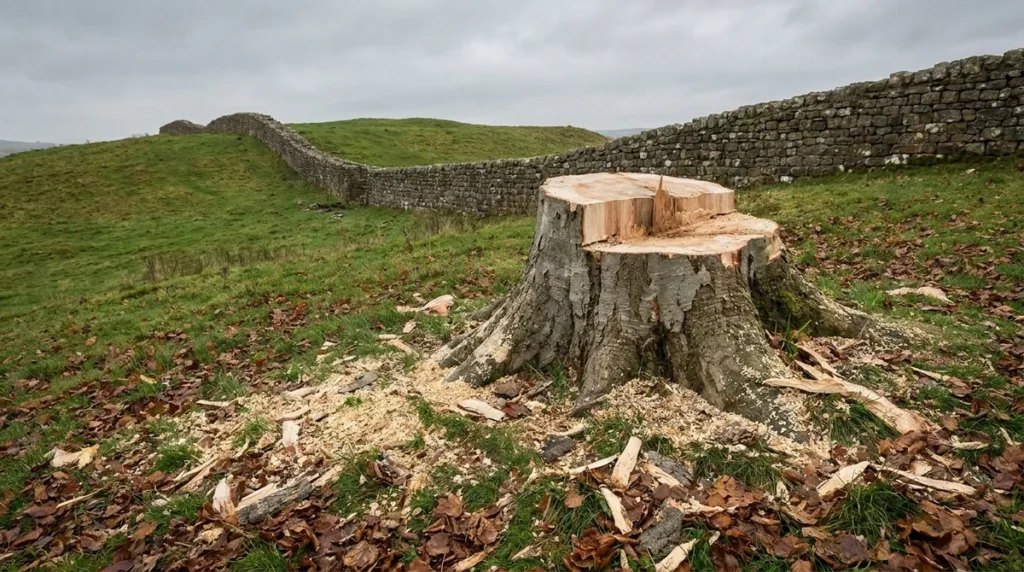
Daniel Graham and Adam Carruthers cut down the Sycamore Gap tree on the night of 27–28 September 2023. A jury at Newcastle Crown Court convicted both men of two counts of criminal damage on 9 May 2025, and on 15 July 2025 each was sentenced to four years and three months in prison.
One point of housekeeping first, because most accounts get it wrong: the tree at Sycamore Gap was an Acer pseudoplatanus — a sycamore maple, which is a maple, not a plane and not a fig. Its own story belongs in our guide to the Sycamore Gap tree. This page covers the criminal case only.
Who are Daniel Graham and Adam Carruthers?
Daniel Graham, then 39, gave his address in court as Millbeck Stables, Carlisle. Adam Carruthers, then 32, gave his as Church Street, Wigton, Cumbria. Mrs Justice Lambert described both in her sentencing remarks as experienced tree surgeons, which matters: the felling was a skilled job, not a drunken hack.
Carruthers had worked for years at Cumbria Turf and had no previous convictions. Graham had four — two for battery, two for public order — but the judge said she did not regard them as relevant or treat them as aggravating. The two had been close friends.
What happened on the night of 27–28 September 2023?
The judge's findings at sentencing are the most reliable account of that night. Late on the evening of 27 September the two men left the Carlisle area in Graham's Range Rover, taking a chainsaw with a blade long enough for the girth of the trunk and a can of spray paint. They drove roughly 40 minutes to the Steel Rigg car park, arriving shortly before midnight, then walked 15 to 20 minutes to the tree in the dark, in the middle of Storm Agnes.
Carruthers marked the trunk with spray paint to guide the wedge cut that creates a felling hinge, then took the tree down. The felling itself lasted no more than two and a half to three minutes. Graham stood a short distance away and filmed it on his phone; the file was created at 00:32. They were back down at the military road by 00:58, carrying the wedge of trunk away as a trophy.
At 01:30, on the drive home, Carruthers's partner sent him a video of their newborn being bottle-fed. He replied: "I've got a better video than that." Nine minutes later Graham forwarded him the video of the felling. At around 2am, back at Graham's yard, they photographed the chainsaw and the wedge in the boot of the Range Rover.
Neither the chainsaw nor the wedge has ever been recovered.
How were they caught?
Not quickly. Detective Inspector Calum Meikle of Northumbria Police described a remote scene with almost no CCTV and a force falling back on old-school policing. What broke it open was information passed to police naming both men. Both were arrested on 31 October 2023.
From there their own phones did most of the work:
- The video. Unenhanced, the 00:32 footage showed essentially nothing. Enhanced, it showed the outline of a man running a chainsaw, pausing to lift the wedge from the trunk, and the tree crashing across the wall. Location data placed it at Sycamore Gap.
- The boot photographs. Expert analysis confirmed their timing and location, and that the objects were in Graham's Range Rover.
- Forensic botany. Ian Everard, who had spent more than 36 years with the Forestry Commission, told the court there was "very strong evidence" that the wedge in the photograph came from the Sycamore Gap tree.
- The messages. At 9:35 the next morning Carruthers sent Graham a photograph of the felled tree on WhatsApp. Graham replied: "here we go." Through the day they traded screenshots and voice notes, one a boast about wanting to see a critic "launch an operation like we did last night".
Then the friendship collapsed. Graham made an anonymous call to police naming Carruthers as the man responsible. Both were charged in late April 2024, and both pleaded not guilty.
What happened at the trial?
The trial ran at Newcastle Crown Court from late April into May 2025. Prosecuting, Richard Wright KC told the jury the pair had filmed their own "moronic mission", and that a tree which took over a century to grow was destroyed in minutes. Neither defendant accepted any involvement; each pointed at the other. On 9 May 2025 the jury convicted both on both counts.
The turn came afterwards. In their pre-sentence interviews with probation officers, both admitted being present while trying to minimise their own part. That let the judge make a finding the trial evidence alone could not support: Carruthers wielded the chainsaw; Graham drove, encouraged and filmed. She rejected Carruthers's claim that a bottle of whisky had wiped his memory — the cut was too skilled and too coordinated — and rejected Graham's claim that he was a shocked bystander, since he filmed the whole thing and spent the next day enjoying the coverage.
Why four years and three months?
This is the number people find strange, and the explanation is procedural rather than moral.
The Sentencing Council guideline for criminal damage over £5,000 sets an offence range from a discharge to four years' custody. That was the judge's ceiling. She placed the felling in the highest category for both culpability and harm — high planning and premeditation, an intention to destroy, and an extraordinary social impact — giving a starting point of 18 months.
She then moved that starting point to the very top of the bracket, and added weight for an aggravating factor that is not in the guideline at all: the two men had savoured the fact that other people, including a teenage boy, were investigated for what they had done. A modest discount followed for the absence of relevant previous convictions. The final figure crossed four years because the sentence on count 1 absorbed part of the sentence for the wall.
| Element | Outcome |
|---|---|
| Count 1 — criminal damage to the tree | 4 years 3 months |
| Count 2 — criminal damage to Hadrian's Wall | 6 months, concurrent |
| Deprivation orders | Graham's Range Rover and mobile phone |
| Release point | No later than 40% of the sentence, remainder on licence |
The judge also noted time already served: Graham had been in custody since 21 December 2024, Carruthers since 9 May 2025.
Was the tree really worth £622,191?
That is the figure on the indictment, and it is the figure that travelled around the world. It is also the figure the court declined to rely on.
Both sides submitted expert valuations. At sentencing the judge recorded that nobody argued the precise financial value mattered: the only legally relevant point was that the tree was worth more than £5,000, the threshold that selects the sentencing range. The £622,191 was a charging figure, not a valuation the court adopted.
The money actually spent is more modest and better documented. Andrew Poad of the National Trust, which owns the tree and that stretch of wall, put the cost of removing the tree and caring for the site at over £30,000 at the time of sentencing, with a further £20,000 committed for 2025. Repairing the wall, including staff costs, came to just under £7,500 — considerably more than the £1,144 named on count 2.
What the judge treated as the real harm was not money but social impact: a landmark in local art and tourism, a place where people proposed and left tributes to the dead, and a reaction the National Trust called unprecedented. Why a single tree carried that weight is the subject of sycamore tree symbolism.
Why the wall was charged separately
A tree is property, and felling someone else's tree is criminal damage without needing any heritage law. Hadrian's Wall added a second count because it is a UNESCO World Heritage Site and a protected monument.
The physical damage was limited — spalling and fracturing of some stones, cushioned, the judge noted, by the tree's own canopy. She accepted the men had not set out to damage the wall but found them reckless: as tree surgeons they would have known the angle of the wedge and the wind made it inevitable the tree would fall across it. On its own, count 2 would have started at a high level community order. Heritage status is what made it custodial — the legal version of a theme running through the cultural history of sycamores: the tree mattered because of where it stood.
Where does the case stand in 2026?
The convictions and the sentence stand. What has changed is where the two men are.
Adam Carruthers was released from prison in March 2026, after roughly ten months in custody, under the Home Detention Curfew scheme — a decision taken by the prison governor after a risk assessment. He is tagged and must spend between nine and around twelve hours a day at his registered address. ITV News Tyne Tees revealed the release on 15 April 2026 and found him back at work at Cumbria Turf. Under the 40% rule the judge described he would not have been released until around January 2027; Home Detention Curfew permits release after half that period. The Ministry of Justice noted that anyone on the scheme can be recalled.
Daniel Graham was still serving his sentence in custody as of April 2026. As of July 2026 no appeal ruling in either case has been reported.
The tree itself is a separate story, and not entirely a bleak one: shoots have come from the stump and the National Trust has been managing them, which belongs with the tree's own history. Why a British "sycamore" is a maple and an American one is not is untangled in sycamore vs maple and in our guide to the types of sycamore tree.
Recommended: